Galaxies

The area around the supermassive black hole at the center of the galaxy M87 seen in the various bands of the electromagnetic spectrum during the 2017 observation campaign

An article published in “The Astrophysical Journal Letters” reports the results of multiband observations of the area around the supermassive black hole at the center of the galaxy M87. 33 members of the Multiwavelength Science Working Group of the Event Horizon Telescope (EHT) led a large team of researchers who put together data collected by the various radio telescopes that made up the EHT in the extraordinary campaign of observations which led to the historical photo published in 2019 and other data of observations in other electromagnetic bands conducted with various space and ground-based telescopes. This allows to conduct more in-depth analyzes thanks to the completeness of the emissions detected not only by the supermassive black hole but also by its jets that eject materials at very high speeds.

The 12 Einstein crosses

An article accepted for publication in “The Astrophysical Journal” reports the identification of 12 quasars whose image has been quadrupled by gravitational lenses obtaining images similar to the so-called Einstein Cross. Researchers from the Gaia Gravitational Lenses (GraL) group used data collected by ESA’s Gaia space probe and NASA’s WISE space telescope and examined them with machine learning algorithms. In this way, it was possible to recognize quasar candidates whose image was distorted by gravitational lenses leading to the identification of 12 Einstein crosses.

The double quasars cataloged as J0749+2255 and J0841+4825

An article published in the journal “Nature Astronomy” reports the discovery of two double quasars that could be part of a hidden population because two quasars that are very close are difficult to distinguish. A team of researchers used Hubble Space Telescope observations of quasars to find these pairs dating back to about 10 billion years ago. The two quasars of each pair are about 10,000 light-years apart, and the galaxies that host them will merge and at a certain point the supermassive black holes that power the quasars will merge as well.

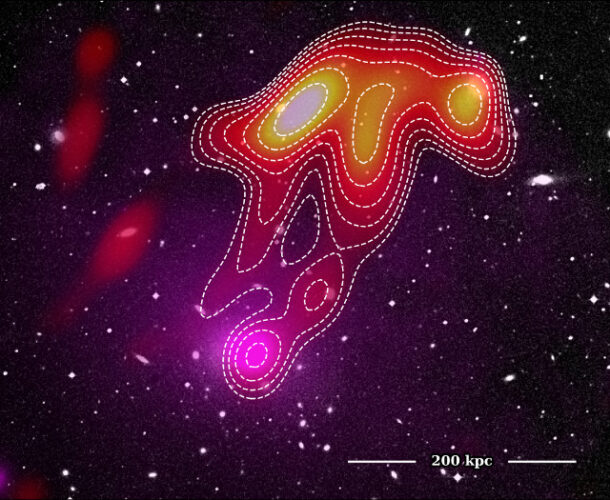
The cosmic jellyfish in the galaxy cluster Abell 2877

An article published in “The Astrophysical Journal” reports a study on the galaxy cluster Abell 2877 conducted with the MWA radio telescope which identified a plasma cloud with a shape similar to a jellyfish. A team led by Torrance Hodgson of the International Center for Radio Astronomy Research (ICRAR) observed Abell 2877 at different radio frequencies and, when they turned the frequency down, they discovered that cosmic structure visible for a short time and only at very few frequencies. It could be plasma ejected about two billion years ago from supermassive black holes in different galaxies that mixed just as shockwaves passed through the cluster, reigniting the plasma for a period that is very short from an astronomical point of view.

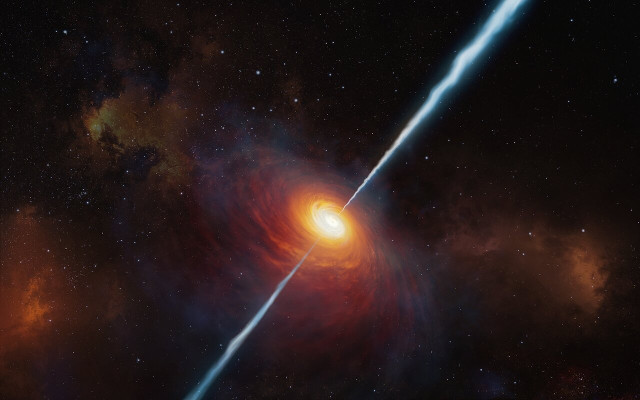
Artist's representation of P172+18 (Image ESO/M. Kornmesser)

An article published in “The Astrophysical Journal” reports the discovery of the farthest radio-loud quasar. A team of researchers led by Chiara Mazzucchelli, a Fellow at ESO in Chile, and Eduardo BaƱados of the Max Planck Institute for Astronomy used various telescopes to identify the quasar cataloged as PSO J172.3556+18.7734 and simply called P172+18. This quasar is about 13 billion years old and that means we see it as it was when the universe was very young, less than 800 million years after the Big Bang. It can offer new insights into the primordial universe and the objects its emissions passed through to reach Earth.