Galaxies

GAL-CLUS-022058s, the Molten Ring (Image ESA/Hubble & NASA, S. Jha. Acknowledgement: L. Shatz)

The Hubble Space Telescope has captured an image of GAL-CLUS-022058s, the largest and one of the most complete Einstein rings ever discovered. This type of structure’s name comes from the fact that it was theorized by Albert Einstein in his theory of general relativity. It’s in fact the result of a gravitational lensing effect, which distorts the image of an object behind a galaxy or a galaxy cluster. In this case, the ring’s “liquid” look and the fact that it was identified in the constellation of Fornax, the Furnace, led to the nickname of “Molten Ring”.

The eROSITA bubbles

An article published in the journal “Nature” reports the discovery of a gigantic structure formed by hot gas with a shape similar to that of an hourglass with lobes that extend from the center of the Milky Way. A team of researchers used observations conducted with eROSITA, one of the instruments of the Spektr-RG space telescope, which identified this structure at X-rays that is very similar to the so-called Fermi bubbles.

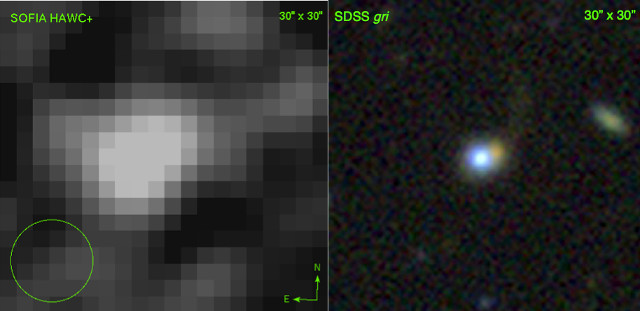
Views of galaxy CQ 4479

An article published in “The Astrophysical Journal” reports a study on the galaxy CQ 4479, where a quasar was observed, an active galactic nucleus with a supermassive black hole that is devouring large amounts of matter, and at the same time an intense star formation. A team of researchers used the SOFIA flying telescope to observe CQ 4479, and found this situation called a cold quasar because the active galactic nucleus is very hot but the galaxy also contains cold gas that gives birth to new stars. This is a rare case that could show an astronomically short period in the evolution of a galaxy before the quasar starts inhibiting star formation.

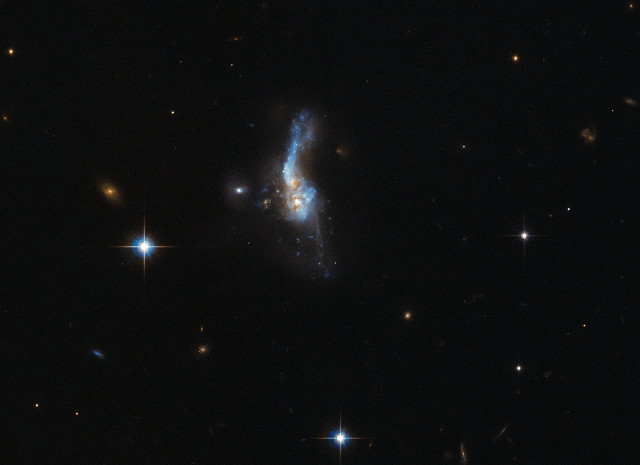
A hyperluminous galaxy seen by Hubble (Image ESA/Hubble)

An article published in the journal “Astronomy & Astrophysics” reports a study on hyperluminous galaxies. A team of researchers led by Lingyu Wang of the Netherlands Institute for Space Research, Utrecht, used the LOFAR radio telescope to assess the amount of hyperluminous galaxies in infrared and concluded that it’s ten times higher than what stars can produce according to current models. If the models are correct, it means that in many galaxies there are other light sources such as an active galactic nucleus powered by a supermassive black hole surrounded by large amounts of materials heated to the point of generating electromagnetic emissions.

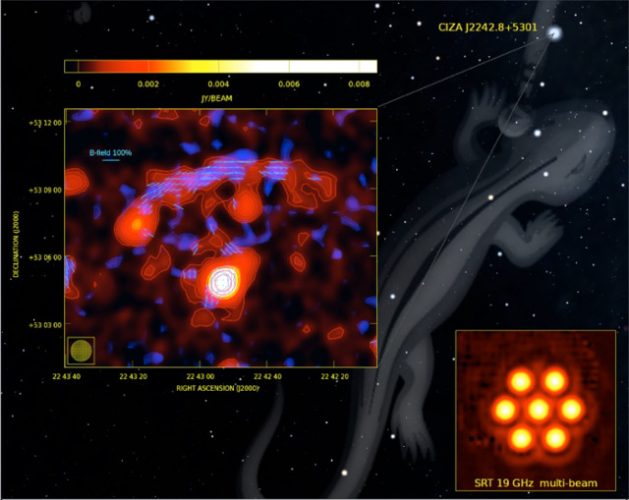
The radio relice in the galaxy cluster CIZA J2242.8+5301

An article published in the journal “Monthly Notices of the Royal Astronomical Society” reports a study on the galaxy cluster CIZA J2242.8+5301. A team of researchers led by astrophysicist Francesca Loi of the Italian National Institute of Astrophysics, Cagliari, used the Sardinia Radio Telescope (SRT) to conduct 240 hours of observations to obtain the highest-frequency spectro-polarimetric image ever produced by a radio telescope of what in jargon is called a radio relic. The quality of the observations enabled to obtain better results than previous studies, which were contradictory, leading to controversy.