Galaxies

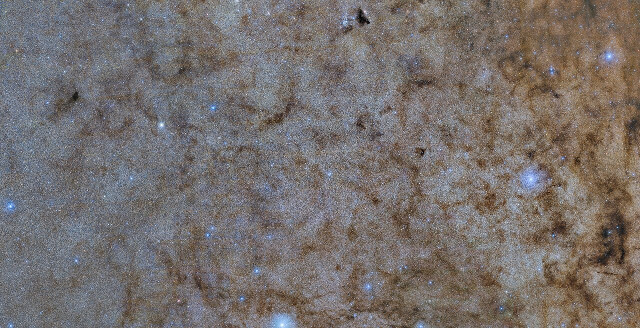
The Milky Way's bulge (Image CTIO/NOIRLab/DOE/NSF/AURA. Image processing: W. Clarkson (UM-Dearborn), C. Johnson (STScI), and M. Rich (UCLA), Travis Rector (University of Alaska Anchorage), Mahdi Zamani & Davide de Martin.)

Two articles published in the journal “Monthly Notices of the Royal Astronomical Society” report different aspects of a research on what is commonly called the bulge, a large group of stars in the central area of ​​the Milky Way. A team of researchers used the Dark Energy Camera (DECam) to conduct observations of the bulge, with its 250 million stars among which in particular the ultraviolet emissions of the ones in the cluster known as red clump were detected because it’s formed by red giants. By analyzing their emissions it was possible to find the spectroscopic traces of the chemical elements inside more than 70,000 stars. The red giants near the center of the Milky Way showed a very similar composition indicating that they formed around the same time, over 10 billion years ago.

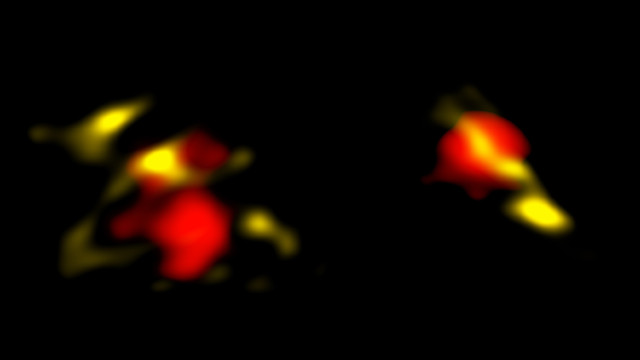
Two dusty galaxies detected by ALMA (Image B. Saxton NRAO/AUI/NSF, ALMA (ESO/NAOJ/NRAO), ALPINE team)

Eight articles published in the journal “Astronomy & Astrophysics” report as many studies connected to the ALPINE (ALMA Large Program to Investigate C+ at Early Times) project, conducted using the ALMA radio telescope in 70 hours of far infrared observations of 118 galaxies in the early universe. The researchers who conducted the various studies discovered among other things galaxies that are more mature than primordial, in the sense that they contain a significant amount of dust and metals, a situation found in galaxies where many stars were already produced and exploded into supernovae. This is a confirmation that the first cases of galaxies that were already mature when the universe was still young were not isolated.

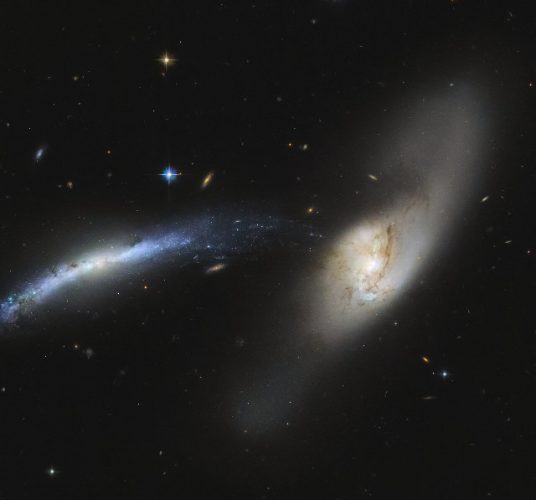
Arp 283 (NGC 2799 and NGC 2798) (Immagine ESA/Hubble & NASA, SDSS, J. Dalcanton Acknowledgement: Judy Schmidt (Geckzilla))

A photo taken by the Hubble Space Telescope shows Arp 283, which is not a single object but a pair of galaxies classified as NGC 2798 (on the right) and NGC 2799 (on the left). Astronomer Halton Arp put this pair in his catalog of peculiar galaxies because they are two interacting galaxies, which means they’re affected by each other’s force of gravity. Arp 283 was compared to a waterspout with stars from NGC 2799 appearing to fall towards NGC 2798 like drops of water. In the distant future, the two galaxies could merge.

Some of the galaxies observed in the GAMA project

An article published in the journal “Monthly Notices of the Royal Astronomical Society” proposes a new way of studying star formation in galaxies. A team of researchers led by Sabine Bellstedt of the International Center for Radio Astronomy Research (ICRAR) developed a technique to analyze the metallicity, which is the abundance of elements heavier than helium, of galaxies. Those elements are produced by stars so their amount increases over time and the more massive ones produce more as well as emit more light. By combining the analysis of metallicity with that of the brightness of galaxies it offers information on the masses of stars. The resulting model offers information on the history of star formation, and the application to a sample of 7,000 galaxies indicates that most stars formed in the first 4 billion years of the universe’s life.

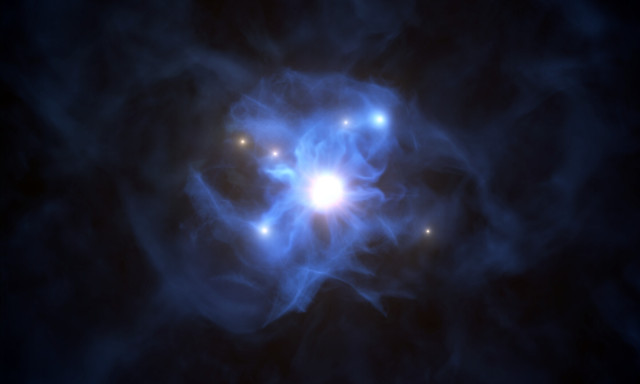
Artist's concept of a supermassive black hole surrounded by galaxies within a cosmic web (Image ESO/L. Calçada)

An article published in the journal “Astronomy & Astrophysics Letters” reports a study on a group of six galaxies surrounding a supermassive black hole which date back to an early epoch when the universe was less than a billion years old. A team of researchers led by Marco Mignoli of the Italian National Institute of Astrophysics (INAF), Bologna, used ESO’s Very Large Telescope (VLT) and the Large Binocular Telescope (LBT) to observe that structure which turned out to be complex as it includes filaments of matter that extend for a distance over 300 times the size of the Milky Way. The gas that concentrates in that structure forms what have been likened to the threads of a spider’s web, and that gas could be responsible for the development of a supermassive black hole in such a remote time.