Galaxies

The galaxy TXS 0128+554 seen by VLBA at various frequencies (Image Lister, et al.; Sophia Dagnello, NRAO/AUI/NSF)

An article published in “The Astrophysical Journal” reports a study of the galaxy TXS 0128+554 and in particular of the jets of particles emitted by the supermassive black hole at its center that form two lobes that appear to have different ages. A team of researchers led by Matthew Lister of Purdue University used the Very Long Baseline Array (VLBA) and NASA’s Chandra X-ray Observatory to observe the jets of materials and gamma-ray emissions. The conclusion is that the jets started about 80 years ago, stopped and then started again about 10 years ago.

The dual quasar SDSS J141637.44+003352.2

An article published in “The Astrophysical Journal” reports the confirmation of three pairs of supermassive black holes in close proximity to the point that we will see them merge in a future that is near from an astronomical point of view. A team of researchers led by Dr. John Silverman of the Kavli Institute for the Physics and Mathematics of the Universe used three observatories on Mount Maunakea in Hawaii: the Subaru Telescope, the Keck Observatory, and the Gemini Observatory to examine a huge amount of quasars in search of traces of a dual center, and among 421 candidates they confirmed three. These are rare cases, to the point that the estimate is that 0.3% of quasars are dual with two supermassive black holes on a collision course.

The galaxy NGC 1365 seen by MUSE (Image ESO/TIMER survey)

ESO has published an image of the galaxy NGC 1365, also known as The Great Barred Spiral Galaxy, captured with the MUSE instrument mounted on the VLT in Chile. The nickname is due to its particular shape with two structures running from its center that extend to its borders. It’s an uncommon type of galaxy since about 15% of galaxies belong to it while spiral ones are common. In this case, there’s a second bar inside the main one. The observations conducted with MUSE will help to understand the dynamics of the stars within NGC 1365 and its supermassive black hole.

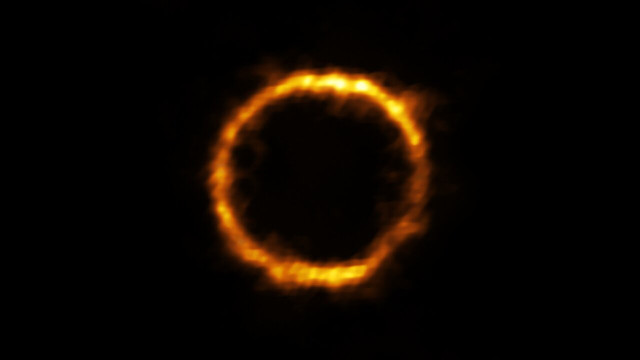
The galaxy SPT0418-47 (Image ALMA (ESO/NAOJ/NRAO), Rizzo et al.)

An article published in the journal “Nature” reports the study of a primordial galaxy we see as it was when the universe was 1.4 billion years old and resembles the Milky Way, a surprise because we see it when it was very young, and according to current theories should be turbulent and unstable. A team of researchers led by Francesca Rizzo, a Ph.D. student at the Max Planck Institute for Astrophysics in Germany, used the ALMA radio telescope to observe this galaxy, cataloged as SPT-S J041839-4751.9, or simply SPT0418-47. Help came from a gravitational lens that magnified the image, allowing to see the similarities with the Milky Way and gather new information on the early stages of galaxy evolution.

The galaxy NGC 4414 (Image University of Oregon)

An article published in “The Astronomical Journal” reports a calculation of the universe expansion rate based on the so-called Tully-Fisher relation, an empirical relationship between the intrinsic brightness of a spiral galaxy and its asymptotic rotation velocity. Professor James Schombert, Stacy McGaugh, and Federico Lelli used the accurate distances of 50 galaxies as a guide to measure the distances of 95 other galaxies and then use those measurements to obtain a measure of the so-called Hubble Constant which has a peak of probability at 75.1 kilometers per second per megaparsec. This measure is very different from those obtained with other methods and, as a consequence, indicates that the universe is approximately 12.6 billion years old compared to approximately 13.8 billion obtained from other research.