Galaxies

Artist's concept of two supermassive black holes in a galaxy

An article published in “The Astrophysical Journal” reports a study of over 2,000 active galactic nuclei (AGN) among which some may have two supermassive black holes. A team of researchers led by Pablo PeƱil, a Ph.D. student at Universidad Complutense de Madrid in Spain, analyzed the data collected in nine years of observations from NASA’s Fermi space telescope to identify gamma-ray emissions that repeat every two years and could indicate the interaction of two supermassive black holes. 11 of the galaxies examined have nuclei with this type of emissions while 13 others show hints of that type of emissions and require follow-up observations to verify their nature.

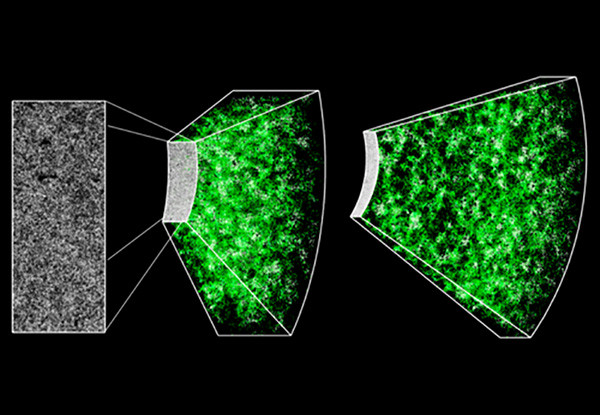
A section of the three-dimensional map of the galaxies of the Sloan Digital Sky Survey used for the analysis

An article published in the journal “Physical Review Letters” reports a new estimate of the expansion of the universe based on the large cosmic structures formed by galaxies. A team of researchers led by Dr. Seshadri Nadathur of the British University of Portsmouth’s Institute of Cosmology and Gravitation (ICG) used data about over one million galaxies and quasars collected over a decade by the Sloan Digital Sky Survey to create an analysis that provided a measure of the effects of the mysterious dark energy that’s accelerating the expansion of the universe. Adding a new method of its calculation doesn’t necessarily lead to the right value, but can help understand why other methods provide incompatible results and where we might need to expand our knowledge of physics to obtain the right value.

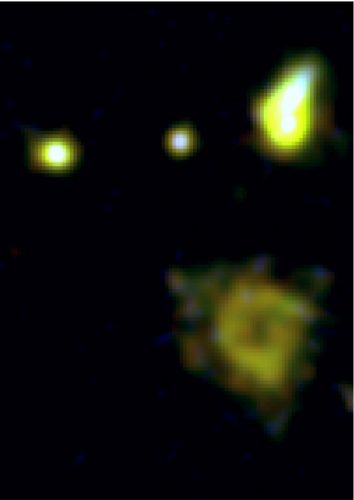
Galaxy R5519 (Image courtesy Tiantian Yuan/Hubble Space Telescope)

An article published in the journal “Nature Astronomy” reports the study of a very rare type of galaxy, called a cosmic ring of fire. A team of researchers led by Dr. Tiantian Yuan from Australia’s ARC Centre of Excellence for All Sky Astrophysics in 3 Dimensions (ASTRO 3D) used spectroscopic images obtained at the Keck Observatory in Hawaii and images captured by the Hubble Space Telescope to identify the strange structure of the galaxy officially designated as R5519. It’s an ancient galaxy, and its discovery may require new changes to current galactic formation models.

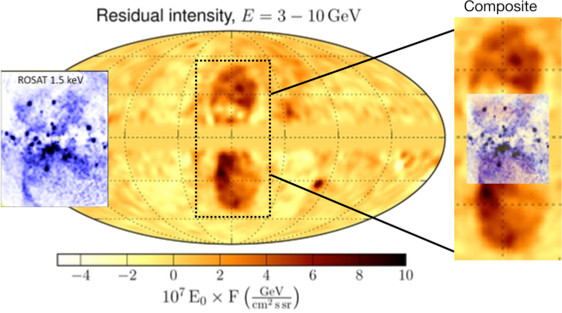
Gamma-ray and X-ray observations of the center of the Milky Way

An article published in “The Astrophysical Journal” offers an explanation of the origin of the so-called Fermi bubbles, the two gigantic gas bubbles existing above and below the center of the Milky Way. Guo Fulai and Zhang Ruiyu of the Shanghai Astronomical Observatory (SHAO) of the Chinese Academy of Sciences conducted a series of simulations that allowed to create a model that explains the origin of the Fermi bubbles and at the same time of the biconical X-ray structure at the center of the galaxy. According to the new model, the two phenomena are caused by shock waves generated by two jets from Sagittarius A*, or simply Sgr A*, the supermassive black hole at the center of the Milky Way, around 5 million years ago.

Artist's concept of the two massive black holes in the OJ 287 galaxy (Image NASA/JPL-Caltech)

An article published in “The Astrophysical Journal Letters” reports observations of a supermassive black hole passing through the disk of materials surrounding another object of the same type but even more massive in the galaxy OJ 287. A team of researchers used NASA’s Spitzer space telescope to monitor this event, which was predicted by a model created specifically to take into account the extreme environment generated in particular by the larger of the two black holes, whose mass is estimated at around 18 billion times the Sun’s. This model, from 2018, is the most recent and takes into account gravitational waves but also the no-hair theorem.