Galaxies

The position of quasars varies over time

An article published in the journal “Monthly Notices of the Royal Astronomical Society” reports evidence that the position of quasars is not fixed. A team of astrophysicists from the Moscow Institute of Physics and Technology combined global observations of 40 quasars between 1994 and 2016 for this study. Based on the fact that the apparent positions of quasars change according to the frequency of the radiation used to observe them, the researchers wanted to verify if that effect could vary over time. Quasars are used as cosmic reference points, knowing their exact location can increase their reliability.

The galaxy MACS0416_Y1 seen by ALMA and Hubble (Image ALMA (ESO/NAOJ/NRAO), NASA/ESA Hubble Space Telescope, Tamura, et al.)

An article published in “The Astrophysical Journal” describes a study on the galaxy MACS0416_Y1. A team of researchers led by Professor Yoichi Tamura of the Japanese University of Nagoya used the ALMA radio telescope to observe a galaxy we see as it was about 13.2 billion years ago. The surprising discovery is the considerable amount of interstellar dust present within it, explained by two intense periods of star formation that took place around 300 million and 600 million years after the Big Bang with a quiet phase between them.

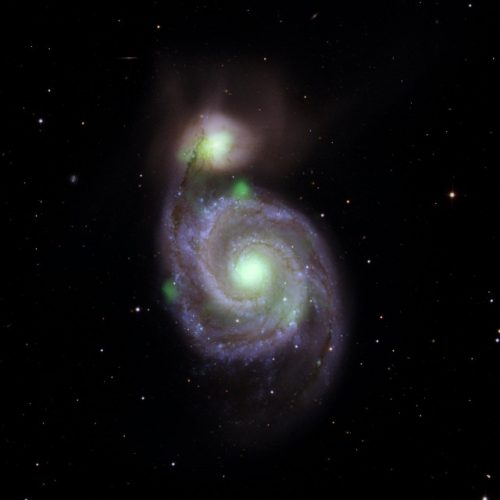
Surprising high-energy X-ray emissions from the Whirlpool Galaxy and its small companion

An article published in “The Astrophysical Journal” presents an in-depth spectral analysis of the two active galactic nuclei and other X-ray sources of the two galaxies that form M51. A team of researchers used NASA’s NuSTAR space telescope to detect high-energy X-ray emissions, which can pass through the layers of dust and gas that orbit the two supermassive black holes at the center of the two galaxies that are interacting in an initial phase of a galactic merger. A surprise came from the emissions of a neutron star in the Whirlpool Galaxy, the larger of the pair.

A newborn star in a giant bubble in the Large Magellanic Cloud

An article published in the journal “Nature” reports the discovery of a jet of materials from a young massive star in an area called LHA 120-N 180B, or simply N180 B, a star formation region in the Large Magellanic Cloud, a satellite galaxy of the Milky Way. A team of researchers led by Anna McLeod used the MUSE instrument installed on the VLT in Chile to study the area and in particular the jet cataloged as HH 1177, the first of this type detected in visible light outside the Milky Way.

The dwarf galaxy Bedin 1 behind the globular star cluster NGC 6752 (Image ESA/Hubble, NASA, Bedin et al.)

An article published in the journal “Monthly Notices of the Royal Astronomical Society Letters” describes the discovery of the most isolated dwarf galaxy detected so far. A team of researchers led by Luigi Bedin of the Italian National Institute of Astrophysics examined observations of the star cluster NGC 6752 carried out with the Hubble Space Telescope for a study of white dwarfs finding a group of very ancient stars that turned out to be a dwarf galaxy that was nicknamed Bedin 1.