Galaxies

The images captured by TESS (NASA/MIT/TESS)

NASA has published a series of images captured by its TESS space telescope’s cameras. These are the first scientific images, that in jargon are called the first light, obtained on August 7, 2018 after the instrument testing period and show the southern sky. The images portray an amount of stars and other objects among which systems where exoplanets were already found. However, the main goal is to discover new exoplanets.

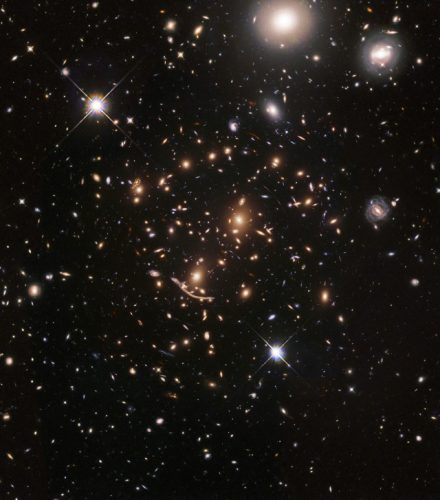
The galaxy cluster Abell 370 (Image NASA, ESA, A. Koekemoer, M. Jauzac, C. Steinhardt, and the BUFFALO team)

The first Hubble Space Telescope’s observations in the new BUFFALO project have been published. Its goal is to shed light on the evolution of the first galaxies of the universe, also to establish the most interesting observation targets for the James Webb space telescope. The Abell 370 galaxy cluster is the first to be studied for this new survey together with a series of galaxies seen through gravitational lenses.

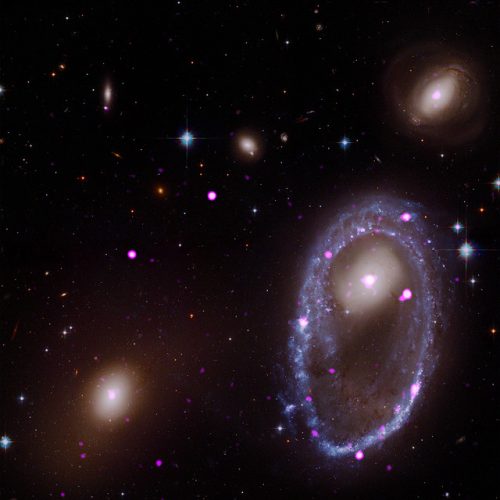
A ring galaxy with a lot of ultraluminous X-ray sources

An article published in the “Astrophysical Journal” describes the detection of a series of X-ray sources in the ring of the galaxy AM 0644-741. A team of researchers led by Anna Wolter from INAF-Osservatorio Astronomico di Brera, Italy, used observations from NASA’s Chandra X-ray Observatory to discover those ultraluminous sources concluding that the ring containing them consists of binary systems that include black holes or neutron stars and that the ring formed following a collision between galaxies.

An ancient galaxy with a frantic star formation

An article published in the journal “Nature” describes the mapping of a galaxy known as COSMOS-AzTEC-1 that showed peculiar characteristics. A team of astronomers used the ALMA radio telescope to study this starburst galaxy, a class in which there’s considerable star formation. COSMOS-AzTEC-1 is very far away so we see it as it was 12.4 million years ago and very massive and could be the progenitor of today’s large elliptical galaxies so this type of research could provide new information on their evolution.

Milky Way panorama (Image ESO/S. Brunier)

An article published in the journal “Nature” describes a research on star formation in the Milky Way. According to Masafumi Noguchi of Tohoku University there were two star formation periods separated by 2 billion years. In essence, our galaxy had a first period in which it was vital then it died and after about 2 billion years star formation restarted in a sort of second life. According to this theory, during that period of death the gas present in the Milky Way got enriched with iron, the reason why stars like the Sun have a greater amount of it than others.