Galaxies

The galaxies Arp 299A and Arp 299B and the tidal disruption event

An article published in the journal “Science” describes the discovery of a star destroyed by a supermassive black hole in what in jargon is called a tidal disruption event. A team of astronomers used various telescopes searching for supernovae in Arp 299, an object generated by two merging galaxies, but in one case they came to realize that the phenomenon in progress was not an explosion but the destruction of the star under observation.

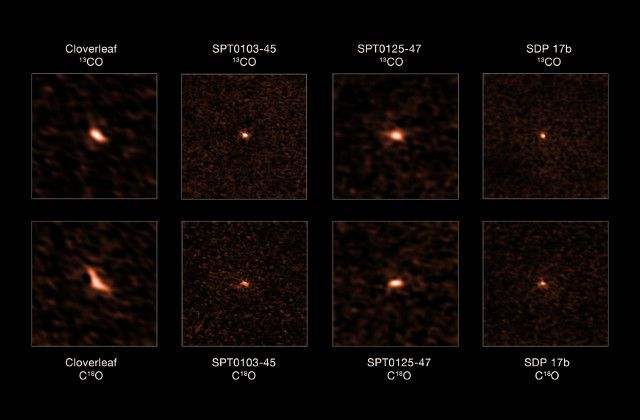
Carbon monoxide in starburst galaxies

An article published in the journal “Nature” describes the discovery of star formation regions where the percentage of massive stars is much higher compared to others. A team of astronomers led by Zhi-Yu Zhang of the University of Edinburgh used the ALMA radio telescope to study four very old dusty galaxies of the starburst type, meaning where there’s a high star formation rate.

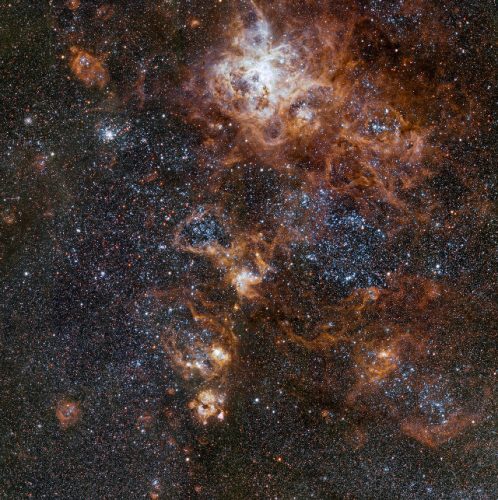
The Tarantula Nebula and its A crowded neighborhood for the Tarantula Nebula (Image ESO)

An image published by ESO shows the Tarantula Nebula along with the neighboring areas in their details. A team of astronomers used the VLT Survey Telescope (VST) at ESO’s Paranal Observatory, in Chile, to capture unseen details of star clusters, bright gas clouds and supernova remnants scattered around. It’s the sharpest image ever obtained of that region of the Large Magellanic Cloud, one of the Milky Way’s satellite dwarf galaxies.

The center of the galaxy NGC 5643 (Image ESO/A. Alonso-Herrero et al.; ALMA (ESO/NAOJ/NRAO))

An image published by ESO and ALMA collaboration shows the center of the galaxy NGC 5643 obtained by combining observations made with the ALMA radio telescope with archive data of the MUSE instrument, mounted on ESO’s VLT. In this way it was possible to see beyond the clouds of dust and gas that obscure it even though it’s an active galactic nucleus with strong electromagnetic emissions generated by the activity of the supermassive black hole at the center of NGC 5643.

The galaxy cluster MACS J1149.5+2223 and in the inset the galaxy MACS1149-JD1

An article published in the journal “Nature” describes the discovery of the most distant traces of oxygen ever detected. A team of astronomers used the ALMA radio telescope and ESO’s VLT telescope to observe the galaxy MACS1149-JD1, where there are traces of star formation about 250 million years after the Big Bang, a very remote era in which so far there were just some clues of possible star formation.