Galaxies

The galaxy NGC 1052-DF2 (Image NASA, ESA, and P. van Dokkum (Yale University))

An article published in the journal “Nature” describes a research on the ultra-diffuse galaxy NGC 1052-DF2. A team of researchers led by Pieter van Dokkum of Yale University, used a number of telescopes to observe this galaxy’s composition concluding that it contains a very low amount of dark matter. The gravitational effects detected in the galaxies show that generally they contain an amount of dark matter much higher than that of ordinary matter but NGC 1052-DF2 is an exception and therefore must be carefully studied.

A measure of the Leading Arm

An article published in the journal “The Astrophysical Journal” describes a research on the Leading Arm of the Magellanic Stream, a huge field of gas clouds that connect the Milky Way to the two Magellanic Clouds, two dwarf galaxies satellite of ours. A team of researchers used the Hubble Space Telescope to study a kind of cosmic tug-of-war between the Large and the Small Magellanic Cloud that generated the cloud that the Milky Way is slowly absorbing.

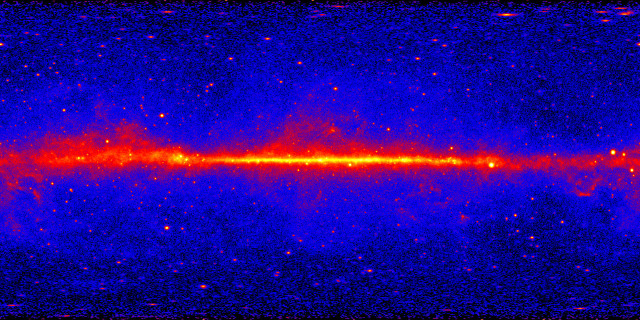
Map of high-energy Gamma Rays (Image NASA/DOE/Fermi LAT Collaboration)

An article published in the journal “Nature Astronomy” describes a research that indicates the origin in an anomalous gamma-ray source detected for the first time in 2009 by the NASA’s Fermi gamma-ray space telescope. One of the hypotheses concerned collisions of dark matter particles, instead according to a team of astronomers there are millisecond pulsars in the nucleus of the Milky Way whose emissions mixed up in the signal detected by Fermi.

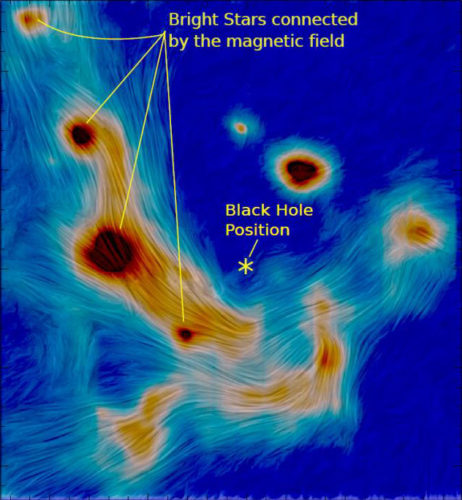
The magnetic field at the center of the Milky Way (Image E. Lopez-Rodriguez / NASA Ames / University of Texas at San Antonio)

An article published in the journal “Monthly Notices of the Royal Astronomical Society” describes the detailed mapping of the magnetic field around Sagittarius A*, also known simply as Sgr A*, the supermassive black hole at the center of the Milky Way. A team of researchers used the CanariCam infrared camera installed on the Grand Telescopio Canarias to obtain the data needed to reproduce the magnetic lines of gas and dust that orbit around the center of the galaxy. The structure of the magnetic lines gives the result a style that reminds of Vincent Van Gogh’s paintings.

Emissions from WISE1029 (Image ALMA (ESO/NAOJ/NRAO), Toba et al.)

An article published in “The Astrophysical Journal” describes a research on gas outflows from the center of an active galaxy. A team of astronomers used the ALMA radio telescope to observe highly ionized gas outflows caused by the supermassive black hole at the center of a dust-obscured galaxy (DOG) known as WISE1029+0501 or simply WISE1029 achieving surprising results. In fact, they detected the “signature” of carbon monoxide associated with the galactic disk but also discovered that the carbon monoxide gas in the galaxy isn’t influenced by the outflow of the strongly ionized gas launched from the galactic center, contradicting the models that seemed more plausible.