Galaxies

Gaia's sky DR2 map (Image ESA/Gaia/DPAC)

ESA has published the second 3D map of the Milky Way and neighbouring galaxies obtained from the Gaia space probe, the most detailed of this type ever produced. This catalog, built thanks to what was called Data Release 2 (DR2), greatly expands the first map released by ESA in September 2016.

The Gaia space probe was launched on December 19, 2013 with the aim of creating a highly accurate 3D map of the Milky Way’s stars but also to catalog billions of other celestial objects, not only stars but also galaxies. Gaia began its scientific activity in July 2014, the first map included data collected until September 2015, the DR2 includes the following 8 months of observations.

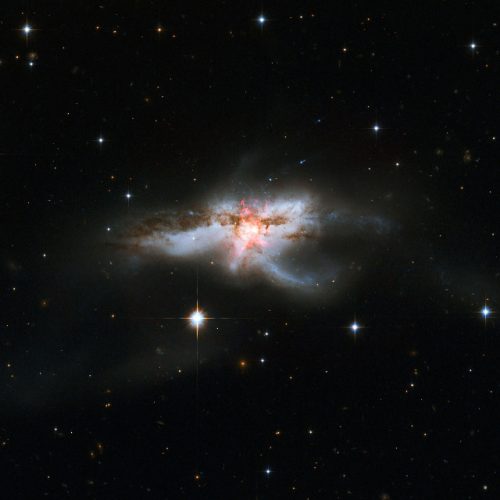
The galaxy NGC 6240 (Image NASA, ESA, the Hubble Heritage (STScI/AURA)-ESA/Hubble Collaboration, and A. Evans (University of Virginia, Charlottesville/NRAO/Stony Brook University))

An article published in the journal “Nature” describes a research on the formations similar to the wings of a butterfly in the galaxy NGC 6240. A team of researchers at the University of Colorado Boulder combined observations made with the Hubble Space Telescope, the VLT in Chile and the Apache Point Observatory in New Mexico to study that galaxy by concluding that those particular formations are generated by different forces, in one case by a pair of supermassive black holes.

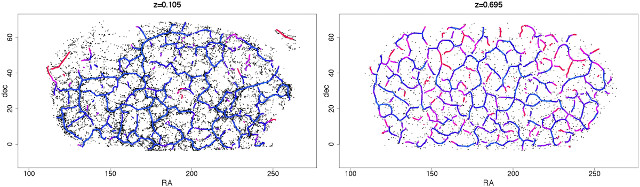
The cosmic web in two moments

An article published in the journal “Nature Astronomy” describes the creation of a map of the network of filaments that connects matter all around the universe. A team of researchers analyzed the data collected during previous surveys to find the gravitational effects that reveal the shapes of those filaments. Those small gravitational distortions suggest that they’re hundreds of millions of light years long and that they’re made of dark matter.

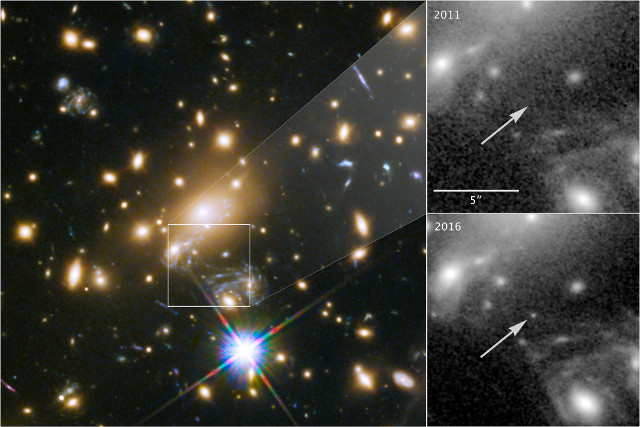
Icarus (MACS J1149+2223 Lensed Star 1)

An article published in the journal “Nature Astronomy” describes the observation of the most distant star and therefore also the oldest observed so far, nicknamed Icarus, about 9 billion light years from Earth. A team of researchers exploited a double gravitational lensing effect that magnified the image of the star, which was called MACS J1149+2223 Lensed Star 1 but for that reason it’s simply called Lensed Star 1 (LS1). That effect made it become bright enough to be detectable by the Hubble Space Telescope.

The galaxy NGC 1052-DF2 (Image NASA, ESA, and P. van Dokkum (Yale University))

An article published in the journal “Nature” describes a research on the ultra-diffuse galaxy NGC 1052-DF2. A team of researchers led by Pieter van Dokkum of Yale University, used a number of telescopes to observe this galaxy’s composition concluding that it contains a very low amount of dark matter. The gravitational effects detected in the galaxies show that generally they contain an amount of dark matter much higher than that of ordinary matter but NGC 1052-DF2 is an exception and therefore must be carefully studied.