Galaxies

The galaxies SDSS J1354+1327 and SDSS J1354+1328 (Image NASA , ESA, and J. Comerford (University of Colorado-Boulder))

An article published in “The Astrophysical Journal” describes the observation of two events consisting of a supermassive black hole that swallowed large amounts of gas and then emits a part of them in the form of very high-energy jets. A team of astronomers led by Julie Comerford of the University of Colorado at Boulder used observations made with various telescopes to capture this repeated activity at the center of a galaxy known as SDSS J1354+1327 or simply J1354.

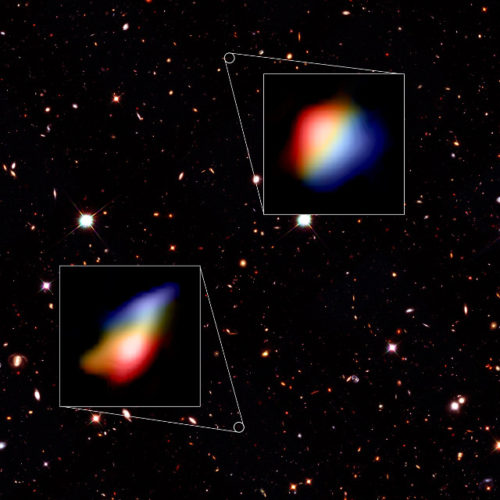
The early galaxies observed by ALMA in the sky observed by Hubble (Image Hubble (NASA/ESA), ALMA (ESO/NAOJ/NRAO), P. Oesch (University of Geneva) and R. Smit (University of Cambridge))

An article published in the journal “Nature” describes the first observation of the movement of gas inside two small newborn galaxies about 13 billion light years away from Earth. A team led by the Dutch astronomer Renske Smit of the Kavli Institute of Cosmology at the University of Cambridge, UK, used the ALMA radio telescope to detect the processes underway in those early galaxies, verifying that the gas moves similarly to galaxies such as Milky Way. These results were also presented at the 231st meeting of the American Astronomical Society, which was held this week.

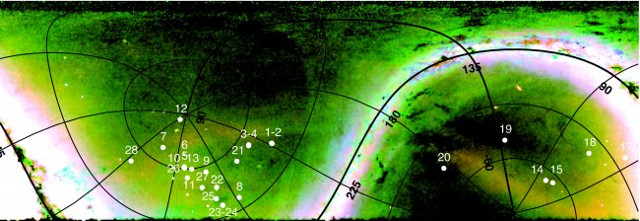
The Milky Way's halo in the Pan-Starrs1 map (Image courtesy Giuseppina Battaglia (Iac))

An article published in the journal “Astronomy & Astrophysics” describes a research on a group of red giant stars located in the halo surrounding the Milky Way. A team of astronomers led by Giuseppina Battaglia of the Istituto de Astrofísica de Canarias examined the composition of a 28-star sample discovering that the presence of some chemical elements is quite different from the halo’s innermost regions. The conclusion is that they were not born in our galaxy but in ancient dwarf galaxies that were absorbed by the Milky Way.

El Gordo (Image ESA/Hubble & NASA, RELICS)

A photo of the galaxy cluster ACT-CL J0102-4915 captured by the Hubble Space Telescope provides a small idea of ​​the vastness of this set of galaxies that has a total mass estimated at 3 million billion times the Sun’s. For this reason it’s been nicknamed “El Gordo”, which in Spanish means “the fat one”. It intensly emits X-rays and that’s another reason of interest for astronomers that led to observe it, discovering that it’s actually formed by two smaller – or less enormous – galaxy clusters that collided.

The galaxy UGC 6093 (Image ESA/Hubble & NASA)

A photo of the galaxy UGC 6093 taken by the Hubble Space Telescope shows some of its interesting features. It’s a barred spiral galaxy, it has an active galactic nucleus powered by a supermassive black hole at its center and acts like a megamaser, which is an astronomical maser that emits microwaves with an intensity about 100 million times greater than that of the astronomical masers found in galaxies such as the Milky Way.