
Galaxies

M77's active galactic nucleus with the gas moving in the inset (Image ALMA (ESO/NAOJ/NRAO), Imanishi et al.)

An article published in the journal “Astrophysical Journal Letter” describes the best observation ever made of a ring of gas and dust surrounding a supermassive black hole. A team of astronomers used the ALMA radio telescope to observe the active galactic nucleus (AGN) of the M77 spiral galaxy that emits the intense electromagnetic radiation detected. This is the definitive proof of what was initially proposed as a theoretical concept for which increasingly clearer evidence was collected over time up to that presented in this research.

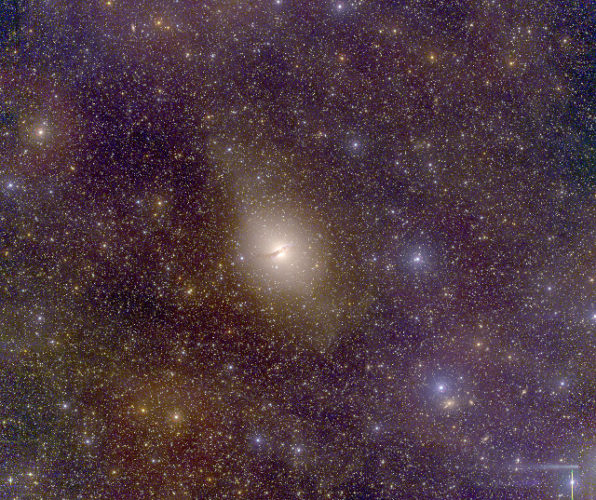
Centaurus A and its dwarf satellite galaxies (Image Christian Wolf and the SkyMapper team / Australian National University)

An article published in the journal “Science” describes a research that shows what appears to be a discrepancy between the observations of a group of galaxies and the current models about dark matter. A team of astronomers determined that 14 of the 16 dwarf satellite galaxies of the Centaurus A galaxy follow a common movement pattern and are arranged on a plane instead of moving in a chaotic way with a random arrangement around the central galaxy.

The Large Magellanic Cloud, the area N113 and the molecules detected (Image NRAO/AUI/NSF; ALMA (ESO/NAOJ/NRAO); Herschel/ESA; NASA/JPL-Caltech; NOAO)

An article published in the journal “The Astrophysical Journal Letters” describes the detection of hot cores and the most complex molecules detected outside the Milky Way in the Large Magellanic Cloud, one of the Milky Way’s satellite dwarf galaxies. A team led by astronomer Marta Sewilo of NASA’s Goddard Space Flight Center used the ALMA radio telescope to conduct those measurements that contradict previous observations in what was considered a chemically primitive galaxy.

The Cartwheel Galaxy (Image ESA/Hubble & NASA)

An image captured by the Hubble Space Telescope shows the Cartwheel Galaxy shows its particular structure that combines features of a lenticular galaxy and a ring galaxy. Its unusual shape is probably the result of a collision with another smaller galaxy that caused a series of shock waves in its nucleus that pushed gas and dust outwards. A long-term consequence of that accumulation of gas in the outer ring is the birth of a lot of massive stars, visible in blue.

The galaxies SDSS J1354+1327 and SDSS J1354+1328 (Image NASA , ESA, and J. Comerford (University of Colorado-Boulder))

An article published in “The Astrophysical Journal” describes the observation of two events consisting of a supermassive black hole that swallowed large amounts of gas and then emits a part of them in the form of very high-energy jets. A team of astronomers led by Julie Comerford of the University of Colorado at Boulder used observations made with various telescopes to capture this repeated activity at the center of a galaxy known as SDSS J1354+1327 or simply J1354.