Galaxies

Two supermassive black holes seen by VLBA (Image Bansal et al., NRAO/AUI/NSF.)

An article published in “The Astrophysical Journal” describes the discovery of the first pair of supermassive black holes orbiting each other at the center of the galaxy hosting them, called 0402+379. A team of astronomers used the Very Long Baseline Array (VLBA) radio telescope to locate the two black holes about 750 million light years from Earth. Their combined mass is about 15 billion times the Sun’s.

The galaxy cluster MACS J2129-0741 and the galaxy MACS2129-1 (Image NASA, ESA, and S. Toft (University of Copenhagen), M. Postman (STScI), and the CLASH team)

An article published in the journal “Nature” describes a study of the galaxy MACS 2129-1. An international team of researchers led by Sune Toft of the Niels Bohr Institute (NBI), University of Copenhagen, Denmark used the Hubble Space Telescope and ESO’s Very Large Telescope (VLT) to gather information about MACS 2129-1. The result is that no new stars are being formed and this is really surprising because it’s very far away so we see it as it was at a time when the universe was at the highest rate of star production.

Artist's concept of galaxies merging near a quasar (Image MPIA using material from the NASA/ESA Hubble Space Telescope)

An article published in the journal “Nature” describes the discovery of four galaxies that are very ancient, so much that they formed less than a billion years after the Big Bang. A very high stellar formation rate was observed within them. A team of astronomers led by Roberto Decarli of the Max Planck Institute for Astronomy discovered by chance these four galaxies, noting that they were close to as many quasars.

A comparison between supermassive black holes in a normal galaxy and in one involved in a galaxy merger (Image National Astronomical Observatory of Japan)

An article published in the journal “Monthly Notices of the Royal Astronomical Society” describes the effects that a merger between two galaxies can have on a supermassive black hole at the center of a galaxy involved in that process. A team of researchers led by Claudio Ricci used especially NASA’s NuSTAR space telescope to study how in the last stages of galactic merger gas and dust fall towards a black hole enshrouding it and generating an active galactic nucleus.

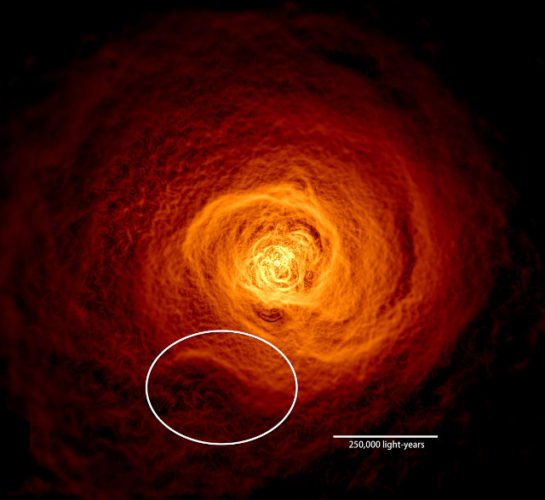
X-ray image of the hot gas in the Perseus galaxy cluster (Image NASA's Goddard Space Flight Center/Stephen Walker et al.)

An article published in the journal “Monthly Notices of the Royal Astronomical Society” describes the discovery of a large wave of hot gas in the Perseus galaxy cluster that extends for about 200,000 light years. A team of astronomers led by Dr. Stephen Walker of NASA’s Goddard Space Flight Center combined observations with NASA’s Chandra X-ray Observatory and others at radio frequencies with computer simulations to study it.