Galaxies

The star cluster NGC 602 (Image ESA/Webb, NASA & CSA, P. Zeidler, E. Sabbi, A. Nota, M. Zamani (ESA/Webb))

An article published in “The Astrophysical Journal” reports the identification of 64 brown dwarf candidates in the star cluster NGC 602 in the Small Magellanic Cloud, one of the Milky Way’s satellite galaxies. A team of researchers used the James Webb Space Telescope to obtain the sensitivity and resolution needed to detect possible objects halfway between the planet and the star about 200,000 light-years away. Follow-up studies are needed to verify these candidates, the first brown dwarfs to be verified outside the Milky Way. NGC 602 is poor in elements heavier than hydrogen and helium, a condition that was normal when the universe was young, further reason for interest in studying the processes within the cluster.

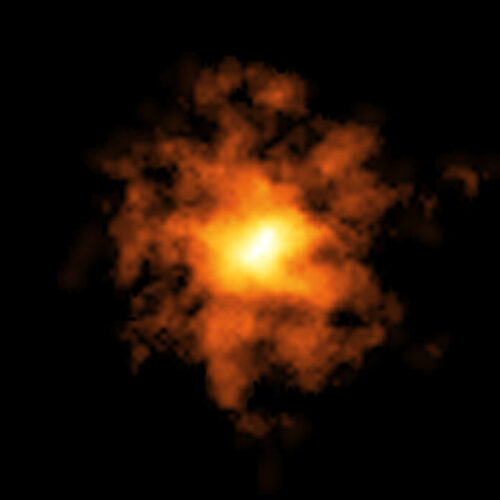
The REBELS-25 galaxy as seen by the ALMA radio telescope (Image ALMA (ESO/NAOJ/NRAO)/L. Rowland et al.)

An article accepted for publication in the journal “Monthly Notices of the Royal Astronomical Society” reports the discovery of a primordial galaxy that was cataloged as REBELS-25 and shows a rotating structure that is already ordered in a way that isn’t expected from such an ancient galaxy. A team of researchers used the ALMA radio telescope to study REBELS-25 and trace the movement of gas within it. The data collected will be invaluable in understanding how a galaxy that we see as it was when the universe was about 700 million years old can have a structure that is already becoming a spiral like the one of the Milky Way at that time.

The area of ​​the sky where the galaxy GS-NDG-9422, or simply 9422, was spotted, magnified in the inset in a view captured by the James Webb Space Telescope's Near Infrared Camera (NIRCam).

An article published in the journal “Monthly Notices of the Royal Astronomical Society” reports the discovery of a primordial galaxy that was cataloged as GS-NDG-9422, or simply 9422, in which nebular gas outshines stars. A team of researchers used observations conducted with the James Webb Space Telescope to study 9422 using in particular the NIRSpec (Near-Infrared Spectrograph) instrument to analyze its chemical composition. The conclusion is that this galaxy is in a phase never seen before in its evolution in which very massive and very hot stars make the nebular gas very hot and consequently bright.

The eROSITA bubbles seen in X-rays (green) and the magnetic field in the halo (white). The red color shows the polarized intensity of synchrotron radiation. The light blue circles represent the Fermi bubbles seen in gamma rays.

An article published in the journal “Nature Astronomy” reports a study of the so-called eROSITA bubbles that reveals magnetized structures that form a galactic halo aligned with them reaching heights of more than 16,000 light-years above the galactic plane. A team of researchers led by the Italian National Institute for Astrophysics conducted an investigation that spans the entire electromagnetic spectrum from radio waves to gamma rays to examine the eROSITA bubbles and map them. The alignment of the magnetized halo with the bubbles suggests a common origin, which could be given by star formation activity.

The Arp 107 pair seen in the near and mid-infrared by a combination of several filters of the James Webb Space Telescope's MIRI and NIRCam instruments

An image captured by the James Webb Space Telescope shows Arp 107, a pair of interacting galaxies. The spiral galaxy UGC 5984 (or PGC 32620) and the elliptical galaxy MCG +05-26-025 (or PGC 32628) will eventually merge. The Arp 107 pair was already studied several times with various telescopes but the combination of the MIRI (Mid-Infrared Instrument) and NIRCam (Near-Infrared Camera) instruments allowed to capture many new details of the star formation activity triggered by the interaction between the two galaxies.