Galaxies

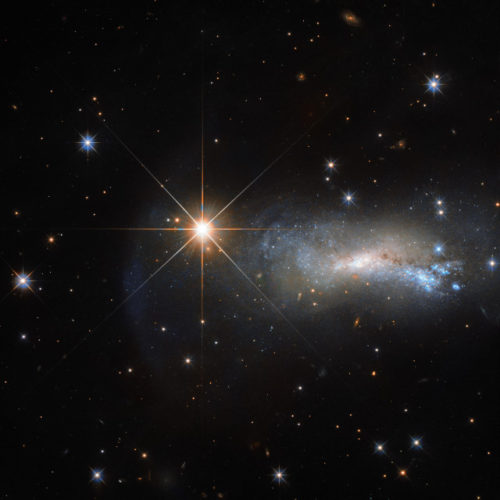
The galaxy NGC 7250 and the star TYC 3203-450-1 (Image ESA/Hubble & NASA)

An image captured by the Hubble Space Telescope portrays the irregular galaxy NGC 7250, along with the star TYC 3203-450-1, which is much closer and thus from the Earth looks much brighter than a whole galaxy. That star’s presence makes studying the galaxy more difficult because its light interferes with NGC 7250’s dimmer light, polluting the observations of an object that’s interesting because of its peculiar characteristics.

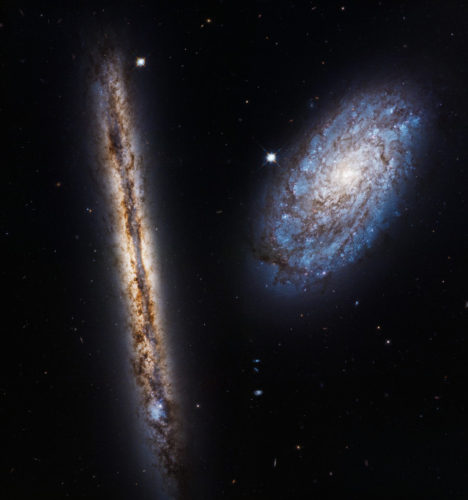
The galaxies NGC 4302 and NGC 4298 (Photo NASA, ESA, and M. Mutchler (STScI))

On April 25, 1990, the Hubble Space Telescope was put into orbit after being launched the day before on the Space Shuttle Discovery. To celebrate that event’s 27th anniversary representing a milestone in the history of astronomy, one of the many breathtaking photographs that accompanied Hubble’s activity was published, which in this case portrays two galaxies together, NGC 4302 and NGC 4298.

Example of galaxy pair connected by dark matter filaments (Image courtesy S. Epps & M. Hudson / University of Waterloo)

An article published in the journal “Monthly Notices of the Royal Astronomical Society” describes a research on dark matter filaments that connect two galaxies. A team of astronomers led by Mike Hudson of the University of Waterloo in Canada exploited a weak gravitational lensing effect to create an image that shows even if indirectly a kind of dark matter bridge between two galaxies.

The galaxy Was 49 (Image DCT/NRL)

A galaxy merger observed with NASA’s NuSTAR space telescope gave surprising results. The galaxy called Was 49 is being formed from the fusion of a large disk galaxy called Was 49a and a dwarf galaxy called Was 49b. The researchers were surprised when they realized that the supermassive black hole at the center of the dwarf galaxy was much bigger and more powerful than expected, going against current models regarding galactic mergers.

The quasar 3C 186 and its galaxy (Image NASA, ESA, and M. Chiaberge (STScI and JHU))

An article published in the journal “Astronomy & Astrophysics” describes the discovery of a supermassive black hole pushed out from its galaxy’s core. A team of astronomers led by Marco Chiaberge of the Space Telescope Science Institute in the USA used the Hubble Space Telescope to observe the quasar 3C 186 in which this phenomenon occurred. Another interesting element is that the black hole’s movement may have been accelerated by gravitational waves.