
Galaxies

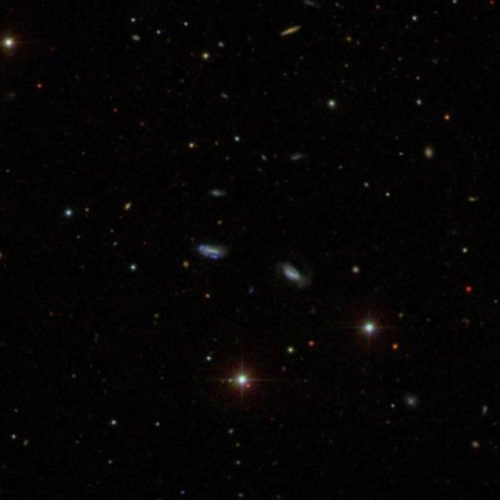
A group of dwarf galaxies (Image courtesy Sloan Digital Sky Survey)

An article published in the journal “Nature Astronomy” describes the discovery of seven groups of dwarf galaxies that show the conditions for starting the merger process that will lead to form galaxies like the Milky Way. A team of researchers led by Sabrina Stierwalt of the National Radio Astronomy Observatory (NRAO) identified seven groups starting from data of the TiNy Titans (TNT) survey then carried out specific studies.

The galaxy RX J1140.1+0307 (Photo ESA/Hubble & NASA. Acknowledgement: Judy Schmidt)

A photo taken by the Hubble Space Telescope shows the galaxy RX J1140.1+0307 and apparently it’s a spiral galaxy like there are a lot, including the Milky Way. However, normally these galaxies have at their center a supermassive black hole, instead RX J1140.1+0307 has a smaller, intermediate-mass black hole. This is an anomaly and astronomers are looking for an explanation.

NGC 1448 in an image combining data from the Carnegie-Irvine Galaxy Survey in the optical range and NuSTAR in the X-ray range (Image NASA/JPL-Caltech/Carnegie-Irvine Galaxy Survey)

At the American Astronomical Society meeting the results of the study of galaxies NGC 1448 and IC 3639 were presented showing how they led to the identification of supermassive black holes at their centers. A team of researchers used NASA’s NuSTAR Space Telescope to detect the high energy X-ray emission from them and see beyond the dust and gas that hid those areas.

Views of the galaxy PGC 1000714 (Image courtesy Ryan Beauchemin)

An article published in the journal “Monthly Notices of the Royal Astronomical Society” describes the discovery of a galaxy of a very rare type, with a central core surrounded by a pair of rings. Called PGC 1000714, it was discovered by a group of researchers at the University of Minnesota Duluth and the North Carolina Museum of Natural Sciences who recognized it as similar to the Hoag’s object, a ring galaxy.

IRAS 16399-0937 (Image ESA/Hubble & NASA. Acknowledgement: Judy Schmidt (geckzilla))

An image obtained thanks to observations made by the Hubble Space Telescope shows a very peculiar galaxy. Called IRAS 16399-0937, it’s a megamaser, which is an astronomical maser that emits microwaves with an intensity about a hundred million times greater than that of astronomical masers found in galaxies like the Milky Way. That’s because virtually all the galaxy is a maser.