Galaxies

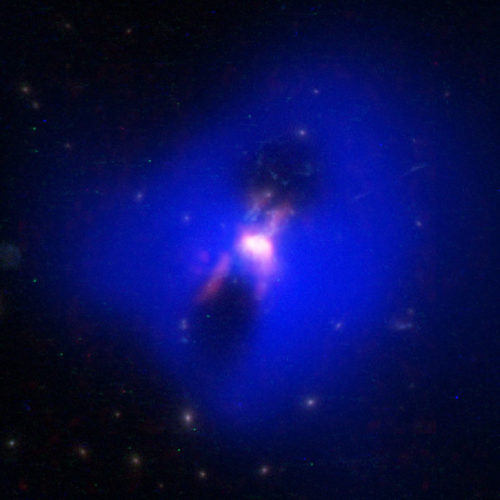
Active galaxy in the heart of the Phoenix Cluster with its jets (Image ALMA (ESO/NAOJ/NRAO) H.Russell, et al.; NASA/ESA Hubble; NASA/CXC/MIT/M.McDonald et al.; B. Saxton (NRAO/AUI/NSF))

An article published in “Astrophysical Journal” describes a research showing a link between a supermassive black hole and the galaxy that hosts it. A team of researchers used the ALMA radio telescope to study a galaxy in the heart of the Phoenix Cluster which has at its core a supermassive black hole that emits electromagnetic radiation jets that are stimulating the birth of new stars.

The Magellanic Clouds (Image V Belokurov, D Erkal, A Mellinger)

An article published in the journal “Monthly Notices of the Royal Astronomical Society” describes the evidence gathered of the existence of a bridge of stars between the two Magellanic Clouds, the two dwarf galaxies satellite of the Milky Way. An international team led by astronomers from the University of Cambridge used data collected by ESA’s Gaia space probe to determine that the bridge is composed not only of gas but also of stars that are old and were stripped from their galaxies.

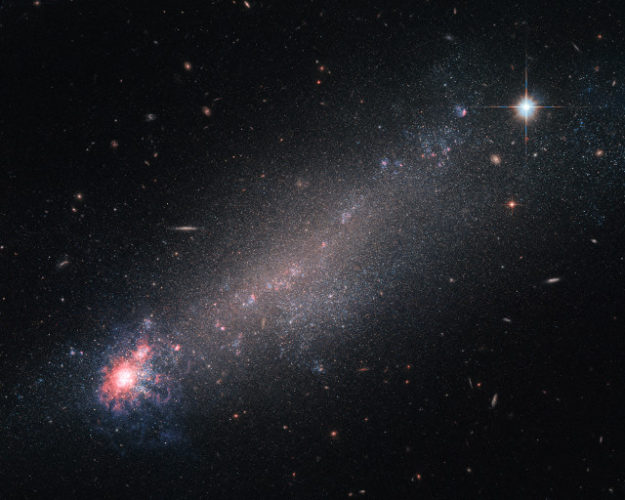
NGC 4861 (Image ESA/Hubble & NASA)

A team of researchers proposed an explanation for the strange appearance of the galaxy NGC 4861, which has the characteristics of a barred spiral galaxy but it looks more like a dwarf irregular galaxy. It’s possible that there’s an ongoing production of charged particle jets during a star formation phase with the generation of galactic winds that explain the strange shape of NGC 4861, similar to a comet.

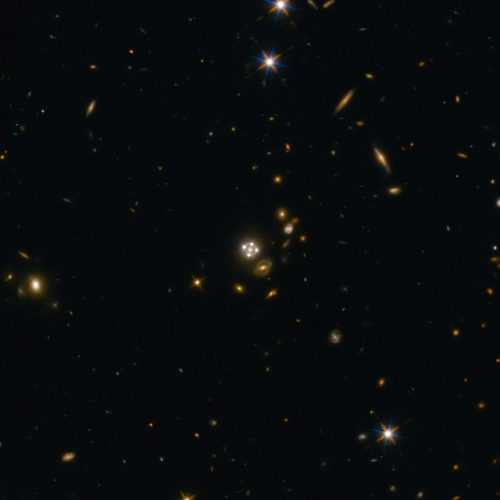
The quasar HE0435-1223 seen through a gravitational lens that creates four images of it (Image ESA/Hubble, NASA, Suyu et al.)

A series of articles about to be published in the journal “Monthly Notices of the Royal Astronomical Society” describes various aspects of a new calculation of the Hubble constant, the value indicating the rate of expansion of the universe. A team of the H0LiCOW collaborative used the Hubble Space Telescope and other telescopes to measure the Hubble constant using the effect of gravitational lensing of 5 galaxies.

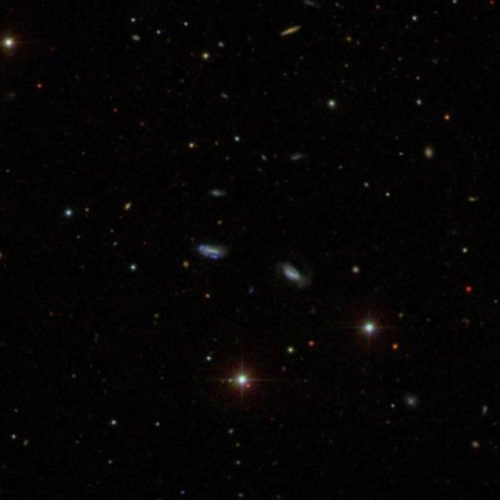
A group of dwarf galaxies (Image courtesy Sloan Digital Sky Survey)

An article published in the journal “Nature Astronomy” describes the discovery of seven groups of dwarf galaxies that show the conditions for starting the merger process that will lead to form galaxies like the Milky Way. A team of researchers led by Sabrina Stierwalt of the National Radio Astronomy Observatory (NRAO) identified seven groups starting from data of the TiNy Titans (TNT) survey then carried out specific studies.