
Galaxies

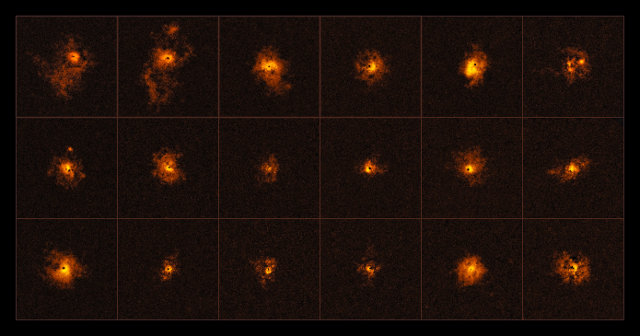
18 of the quasars studied (Image ESO/Borisova et al.)

An article to be published in “The Astrophysical Journal” describes an investigation into the glowing gas clouds around distant quasars. An international team of astronomers led by a group at the ETH (Swiss Federal Institute of Technology) in Zurich, Switzerland, used the MUSE instrument mounted on ESO’s Very Large Telescope (VLT) to look at very distant galaxies that are active, of the type called quasar, and discovered that the gas halos that surround them are more common than expected.

HI4PI survey map (Image courtesy Benjamin Winkel, Max Planck Institute, and the HI4PI collaboration.)

An article published in the journal “Astronomy & Astrophysics” describes the creation of a map of neutral atomic hydrogen in the Milky Way. An international team of scientists put together data collected by two of the largest steerable radio telescopes in the world, the 100-m Max-Planck radio telescope in Effelsberg, Germany and the 64-m CSIRO radio telescope in Parkes, Australia.

The central part of the Milky Way (Image ESO/VVV Survey/D. Minniti)

An article published in “The Astrophysical Journal Letters” describes the discovery of the relics of an ancient globular cluster in the Milky Way’s central area. A team of astronomers led by Dante Minniti (Universidad AndrĂ©s Bello, Santiago, Chile) and Rodrigo Contreras Ramos (Instituto Milenio de AstrofĂ­sica, Santiago, Chile) used observations from the “Variables in the Via Lactea with VISTA” (VVV) survey carried out with ESO’s VISTA telescope to discover the ancient stars of type RR Lyrae for the first time in that area.

Galaxies rich in carbon monoxide seen in orange together with the ones seen by Hubble in blue (Image B. Saxton (NRAO/AUI/NSF); ALMA (ESO/NAOJ/NRAO); NASA/ESA Hubble)

A series of articles to be published in “Astrophysical Journal” and “Monthly Notices of the Royal Astronomical Society” describe different parts of a research based on the observation of the Hubble Space Telescope’s Ultra Deep Field (HUDF) using the radio telescope ALMA. These observations show that the rate of star formation in young galaxies is closely related to their total mass in stars.