Galaxies

VIPERS survey's map (Image B. Granett, L. Guzzo & the VIPERS Collaboration)

In recent days, two groups of researchers have published their cosmic maps. The VIPERS project used the VIMOS spectrograph installed on ESO’s VLT (Very Large Telescope) to examine 90,000 galaxies and create a wide and highly accurate three-dimensional map of the distant universe. The Pan-STARRS project used the telescope at Haleakala, Hawaii, to obtain repeated images of three-quarters of the visible sky and create a map of billions of space objects.

Area around the Milky Way's center (Image courtesy Alex Mellinger)

An article published in the journal “Monthly Notices of the Royal Astronomical Society” describes the discovery of a new family of stars at the center of the Milky Way tha are unusually nitrogen-rich. A team of astronomers from the Liverpool John Moores University (LJMU) made this discovery working on the APOGEE (the Apache Point Observatory Galactic Evolution Experiment) project, which aims to collect infrared data of hundreds of thousands of stars in the Milky Way.

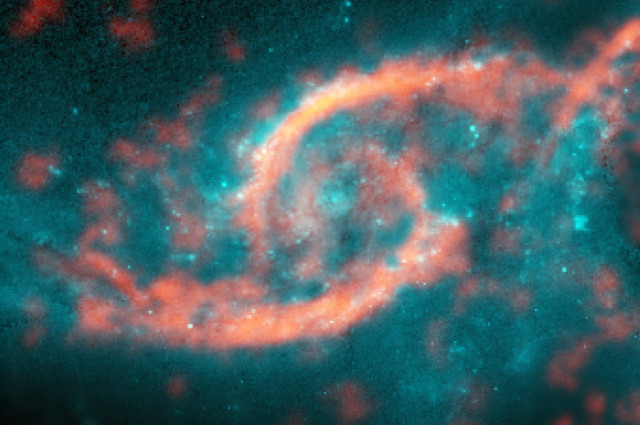
The galaxy IC 2163 (Image M. Kaufman; B. Saxton (NRAO/AUI/NSF); ALMA (ESO/NAOJ/NRAO); NASA/ESA Hubble Space Telescope)

An article published in “Astrophysical Journal” describes a research about the eye-shape galaxy IC 2163, due to a collision with another galaxy called NGC 2207. A team of researchers led by astronomer Michele Kaufman used the ALMA radio telescope to study this kind of tsunami of stars and gas that took on a very rare form among the known galaxies.

Artistic representation of the galactic encounter that generated B3 1715+425 (Image Bill Saxton, NRAO/AUI/NSF)

An article published in the “Astrophysical Journal” describes the discovery of the remnants of a galaxy of which only a small core remained after passing through a larger galaxy. A team of astronomers used the VLBA radio telescope to find this unique object cataloged as B3 1715+425 with a diameter that is now only 3,000 light-years and a supermassive black hole at its center.

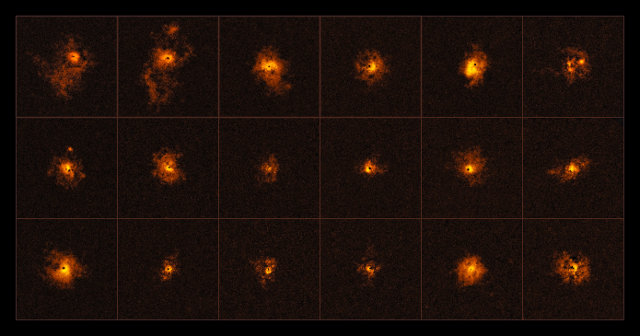
18 of the quasars studied (Image ESO/Borisova et al.)

An article to be published in “The Astrophysical Journal” describes an investigation into the glowing gas clouds around distant quasars. An international team of astronomers led by a group at the ETH (Swiss Federal Institute of Technology) in Zurich, Switzerland, used the MUSE instrument mounted on ESO’s Very Large Telescope (VLT) to look at very distant galaxies that are active, of the type called quasar, and discovered that the gas halos that surround them are more common than expected.