Galaxies

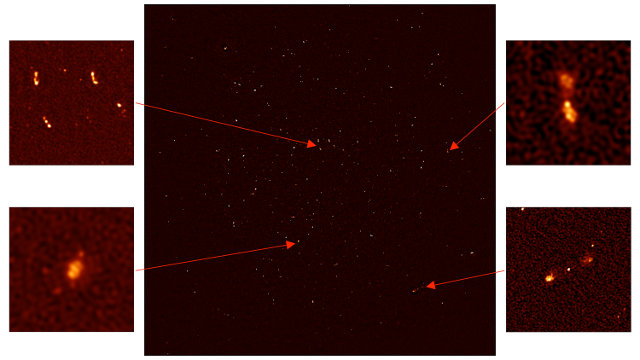
The galaxies seen by MeerKAT with some in details in the insets (Image courtesy SKA Africa. All rights reserved)

The radio telescope MeerKAT has been activated and the first images of the observations have been released. MeerKAT’s sensitivity was immediately demonstrated because in the observed area 70 galaxies were known but over 1300 have been detected. It’s a great achievement for one of the precursors of the SKA project, the next-generation radio telescope whose activation is scheduled for 2020.

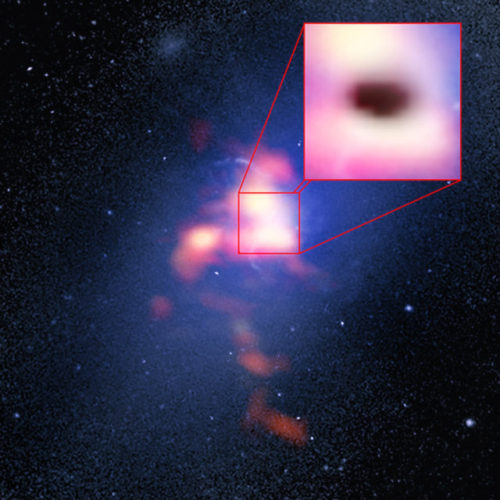
In the background an image taken by the Hubble Space Telescope. In red the gas seen by ALMA (Image B. Saxton (NRAO/AUI/NSF)/G. Tremblay et al./NASA/ESA Hubble/ALMA (ESO/NAOJ/NRAO))

An article published in the journal “Nature” describes the observation of an intergalactic deluge of gases that from large clouds are falling toward the supermassive black hole at the center of a galaxy in the Abell 2597 cluster. By using the ALMA radio telescope a team of astronomers led by Grant Tremblay of Yale University discovered the first evidence that these huge black holes can gorge on gas through chaotic and clumpy rains of giant clouds of very cold molecular gas.

The galaxy UGC 9391 seen by the Hubble Space Telescope. Cepheid variable are in red circles, a type Ia supernova is marked by a blue cross (Image NASA, ESA, and A. Riess (STScI/JHU))

An article accepted for publication in “The Astrophysical Journal” describes a research based on observations made with the Hubble Space Telescope that suggests that the universe is expanding at a faster rate than expected. A team of astronomers led by Nobel laureate Adam Riess measured the distance of stars in nineteen galaxies with the best accuracy ever achieved to obtain this surprising result.

The center of the Milky Way seen by the Herschel Space Telescope (ESA/Herschel/PACS, SPIRE/Hi-GAL Project. Acknowledgement: G. Li Causi, IAPS/INAF, Italy)

An article published in the journal “Astronomy & Astrophysics” presents maps and a catalog of compact sources obtained thanks to a project called Herschel infrared Galactic Plane Survey (Hi-GAL). The observations made during the ESA Herschel Space Telescope’s mission were used to create maps of the complete Plan Galactic in the far infrared with a level of completeness never seen before.