Galaxies

The early massive galaxies just discovered marked in red circles (Image ESO/UltraVISTA team. Acknowledgement: TERAPIX/CNRS/INSU/CASU)

An article published in the journal “Astrophysical Journal” describes the discovery of the oldest giant galaxies carried out thanks to ESO’s VISTA (Visible and Infrared Survey Telescope for Astronomy) telescope. A team of astronomers led by Karina Caputi of the Kapteyn Astronomical Institute at the University of Groningen, Netherlands, identified galaxies that existed when the universe was between 750 million and 2.1 billion years old. This result is surprising because the birth of galaxies so massive wasn’t expected so soon.

The galaxy MCG+01-02-015, also known as LEDA 1852 (Photo ESA/Hubble & NASA and N. Grogin (STScI), Acknowledgement: Judy Schmidt)

The galaxy MCG+01-02-015, also known as LEDA 1852, got photographed using the Hubble Space Telescope’s Advanced Camera for Surveys (ACS) instrument. The special characteristic of this galaxy is that it’s extremely isolated. Generally, galaxies are part of clusters which are in turn part of larger formations, bonded together in structures called galactic filaments, formations at a really huge scale. Among these filaments, however, there are cosmic voids in which sometimes there may be a lonely galaxy.

The galaxy cluster MACS J0416.1–2403 observed by the Hubble Space Telescope (Image NASA, ESA and the HST Frontier Fields team (STScI))

An international team led by the astronomer Hakim Atek of the Ecole Polytechnique Fédérale de Lausanne, Switzerland, used the Hubble Space Telescope to observe over 250 dwarf galaxies that existed between 600 and 900 million years after the Big Bang. It’s one of the largest samples of dwarf galaxies discovered so far dating back to such a remote era and allows us to look into the universe at a young age providing useful information to understand its evolution.

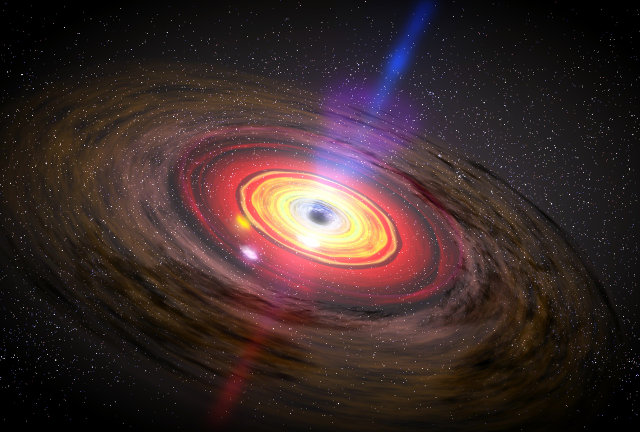
A still frame from a movie showing an active galactic nucleus (Image NASA / Dana Berry / SkyWorks Digital)

An article in the journal “Monthly Notices of the Royal Astronomical Society” describes a study of the galaxy SAGE0536AGN and in particular the supermassive black hole at its center, which is 30 times larger than expected. This is the result of measurements conducted by a team of astronomers at Keele University and the University of Central Lancashire, an anomaly all to explain.

At left is the galaxy J0702+5002, which the researchers concluded is not an X-shaped galaxy whose form is caused by a merger. At right is the galaxy J1043+3131, which is a "true" candidate for a merged system (Image Roberts, et al., NRAO/AUI/NSF)

While in the field of astrophysics are still talking about a pair of supermassive black holes that will clash in the future, a new study suggests that these situations are rarer than expected. A team of astronomers led by David Roberts of Brandeis University analyzed data collected with the VLA (Very Large Array) to examine cases in which possible galaxy mergers the brought supermassive black holes at their centers to form a pair. The conclusion is that in many cases the galaxy merger is only apparent.