JAXA

The HTV-9 cargo spacecraft captured by the Canadarm2 robotic arm (Image NASA TV)

A little while ago the HTV-9 “Kounotori” spacecraft was captured by the International Space Station’s Canadarm2 robotic arm, operated by Chris Cassidy with the assistance of Ivan Vagner. The Japanese space cargo ship, which blasted off last Wednesday, carries a huge amount of supplies and experiments. After its capture, they started the slow moving of HTV-9 to its berthing location on the Harmony module, where it will be safely installed.

The HTV-9 spacecraft blasting off atop a H-IIB rocket (Image courtesy JAXA)

A little while ago the HTV-9 spacecraft blasted off atop a H-IIB rocket from the Tanegashima space center in Japan for a resupply mission to the International Space Station. About fifteen minutes after the launch, the cargo spacecraft separated regularly from the rocket’s last stage, entered its preliminary orbit and deployed its solar panels and navigation antennas.

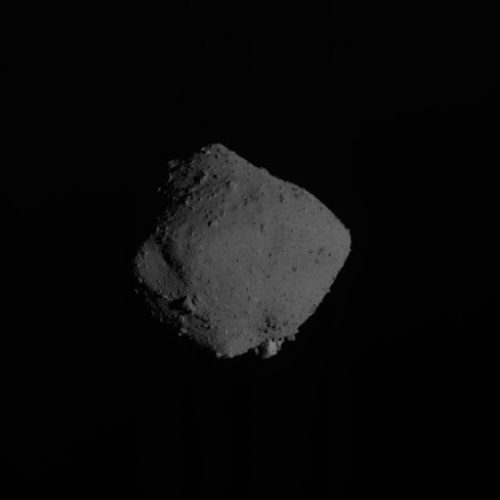
Asteroid Ryugu (Photo courtesy JAXA, Chiba Institute of Technology, University of Tokyo, Kochi University, Rikkyo University, Nagoya University, Meiji University, University of Aizu, AIST)

The Japanese space agency JAXA has confirmed that its Hayabusa 2 space probe has left asteroid Ryugu, reached on June 27, 2018. Until November 19 it will keep on taking pictures of Ryugu, a limit due to the fact that subsequently a maneuver needed to use its ion engine will lead it to turn into a position from which it will no longer have the asteroid in its camera’s view. Until that day, it will be possible to send a farewell message to Ryugu via Twitter or even letters and postcards to JAXA. Hayabusa 2 is scheduled to return near the Earth with its samples near the end of 2020.

The HTV-8 cargo spacecraft captured by the International Space Station's Canadarm2 robotic arm (Image NASA TV)

A little while ago the HTV-8 “Kounotori” spacecraft was captured by the International Space Station’s Canadarm2 robotic arm, operated by Christina Koch with the assistance of Andrew Morgan. The Japanese space cargo ship, which blasted off last Tuesday, carries a huge amount of supplies and experiments. After its capture, the HTV-8 got slowly moved to its berthing location on the Harmony module, where it was safely installed.

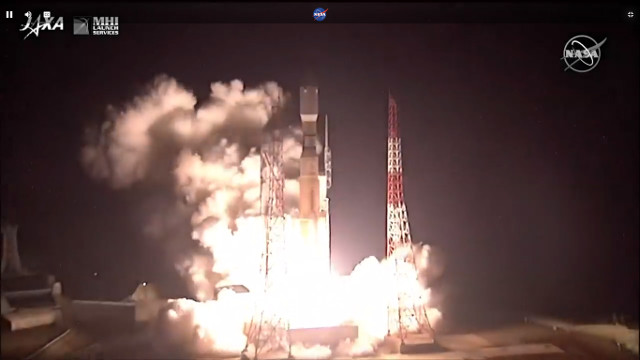
The HTV-8 cargo spacecraft blasting off atop a H-IIB rocket (Image JAXA / NASA TV)

A little while ago the HTV-8 spacecraft blasted off atop a H-IIB rocket from the Tanegashima space center in Japan for a resupply mission to the International Space Station. About fifteen minutes after the launch, the cargo spacecraft separated regularly from the rocket’s last stage, entered its preliminary orbit and deployed its solar panels and navigation antennas.