JAXA

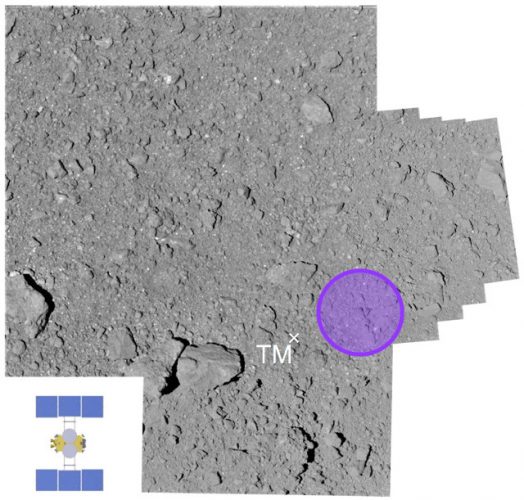
Photo of asteroid Ryugu's soil taken by the ONC-W1 camera (Photo courtesy JAXA. All rights reserved)

A few hours ago the Japanese space probe Hayabusa 2 touched down on the soil of asteroid Ryugu to collect some subsurface samples that will be transported to Earth. This is the second attempt of the three possible at the start of the mission. After the first sample taken on February 22, 2019, the Japanese space agency JAXA decided to proceed with a second attempt in another area to then finish Ryugu’s study and return to Earth with the samples taken.

The Hayabusa 2 space probe generated a crater on asteroid Ryugu

A few hours ago the Japanese space probe Hayabusa 2 generated a crater on asteroid Ryugu, an operation that aims to remove materials from its surface to be able to take samples of subsoil materials that weren’t altered by exposure to space weather. The system called Small Carry-on Impactor (SCI) launched a 2.5 kg copper bullet that was fired into the surface by an explosive system. In a couple of weeks, Hayabusa 2 is scheduled to return to the site to take debris samples.

Asteroid Ryugu (Image courtesy Seiji Sugita et al., Science)

Three articles published in the journal “Science” describe as many researches on asteroid Ryugu. Three teams of researchers used the data collected by the Japanese space agency JAXA’s Hayabusa2 space probe to obtain the first precise descriptions of the characteristics of Ryugu and in particular its geology. The portrait that comes out is that of a porous asteroid containing hydrated minerals and at the same time very little water. It probably formed by a part of the debris of a larger asteroid that got destroyed.

The L08-E1 area on asteroid Ryugu touched by Hayabusa 2 (Image courtesy JAXA)

A few hours ago, the Japanese space probe Hayabusa 2 touched down on the soil of asteroid Ryugu to collect some samples of regolith, the soil’s surface layer, which will be transported back to Earth. This is the first of the three possible attempts and now the Japanese space agency JAXA will have to assess whether to look for another area on the asteroid and proceed with a second attempt.

BepiColombo's space probe blasting off atop an Ariane 5 rocket (Photo courtesy ESA-CNES-Arianespace)

A few hours ago the two space probes of ESA and JAXA’s BepiColombo mission blasted off on an Ariane 5 ECA rocket from the Kourou base in French Guiana. Almost 27 minutes after launch, the spacecraft regularly separated from the rocket’s last stage along with the Mercury Transfer Module (MTM), which will provide the propulsion through its ion engines to transport the probes to the planet Mercury.