
Launches

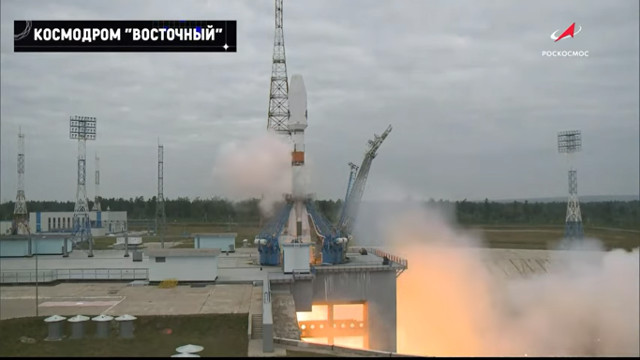
The Luna 25 lander blasting off atop a Soyuz-2.1b (Image courtesy Roscosmos)

A few hours ago, the Luna 25 lander blasted off atop a Soyuz-2.1b rocket from the Russian Vostochny Cosmodrome. After about an hour, the Fregat-M last stage pushed the vehicle to leave Earth orbit, performing the maneuver called in jargon TLI (Tras Lunar Injection) which will take it towards the Moon, where it will land near the south pole, near the Boguslavsky crater.

The Luna 25 mission is the first of the Luna-Glob program, which began in the 1990s with the ambition to reprise the Soviet Luna program and develop it in a way that wasn’t possible in the 1970s. For this reason, the name is Luna 25, considering it the follow-up mission to the 1976 Luna 24.

The Cygnus S.S. Laurel Clark cargo spacecraft blasting off atop an Antares rocket (Photo NASA/Terry Zaperach)

A few hours ago, Northrop Grumman’s Cygnus spacecraft blasted off atop an Antares rocket from the Mid-Atlantic Regional Spaceport (MARS), part of NASA’s Wallops Flight Facility (WFF) on Wallops Island. After about nine minutes it successfully separated from the rocket’s last stage and went en route to its destination. This is the mission called NG-19 or CRS NG-19 to transport supplies to the International Space Station for NASA.

The launch of Chandrayaan 3 mission (Image courtesy ISRO)

A little while ago, a GSLV Mk-III rocket blasted off from India’s Satish Dhawan Space Centre with the Chandrayaan 3 mission’s Vikram lander and Pragyaan rover. After just over 16 minutes, the vehicles separated from the rocket’s last stage to begin the series of maneuvers that will gradually stretch their orbit until they are brought into the area of influence of the Moon, where the lander and rover will land on August 23 in this follow-up to the Chandrayaan 2 mission.

The Euclid Space Telescope blasting off atop a Falcon 9 rocket (Image courtesy SpaceX)

A little while ago, ESA’s Euclid Space Telescope was launched atop a SpaceX Falcon 9 rocket from Cape Canaveral. After just over 40 minutes, it successfully separated from the rocket’s last stage and entered its course that will take it towards the so-called L2 point, about 1.5 million kilometers from Earth, where its scientific mission will begin with an investigation of the dark universe.

The Euclid Space Telescope mission is focused on the cosmological mysteries connected to dark matter and dark energy. Cosmological research in recent decades indicates that the universe we see with the ordinary matter that forms galaxies constitutes only a small part of the cosmos. Astronomers and physicists are having difficulty investigating parts of the cosmos that we can neither see nor directly detect. It’s a problem that makes it difficult to test models that try to explain the effects that led to hypothesize the existence of dark matter and dark energy. For this reason, ESA developed a scientific mission focused on these cosmological problems.

The Dragon 2 spacecraft starts its CRS-28 mission blasting off atop a Falcon 9 rocket (Image NASA TV)

A little while ago, the SpaceX Dragon 2 spacecraft blasted off atop a Falcon 9 rocket from the Kennedy Space Center in its CRS-28 (Cargo Resupply Service 28) mission, also referred to as SPX-28. After almost exactly 12 minutes it separated successfully from the rocket’s last stage and went en route. This is the 28th mission for the Dragon/Dragon 2 spacecraft to resupply the International Space Station with various cargoes and then return to Earth, again with various cargoes.