Launches

The Soyuz MS-22 spacecraft approaching the International Space Station (Image NASA TV)

A few hours ago, the Soyuz MS-22 spacecraft was launched from the Baikonur Cosmodrome in Kazakhstan and after a little more than three hours reached the International Space Station with three new crew members on board. It docked with the Station’s Rassvet module. As is becoming increasingly common for crewed trips as well, the ultra-fast track was used which halves the journey duration.

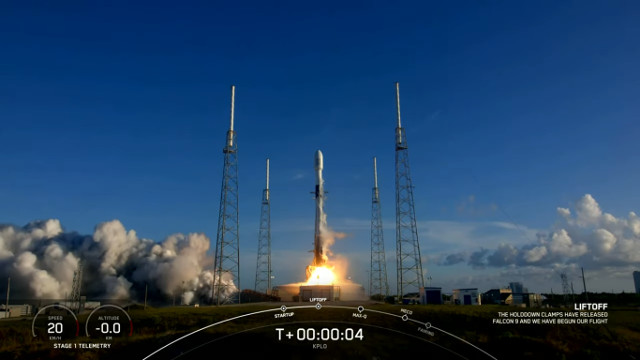
The Danuri space probe blasting off atop a Falcon 9 rocket (Image courtesy SpaceX)

A few hours ago the Korea Pathfinder Lunar Orbiter (KPLO) space probe, which recently received the official name Danuri, blasted off atop a SpaceX Falcon 9 rocket from Cape Canaveral. After just over 40 minutes, it successfully separated from the rocket’s last stage and began the series of maneuvers that will take it into the Moon’s orbit. It’s a long journey planned using what is technically called Ballistic Lunar Transfer (BLT) to optimize efficiency and save the onboard fuel. This means that it will enter the Moon’s orbit only on December 16. If everything works well, Danuri will begin its one-year scientific mission in which its instruments will conduct various surveys.

The Wentian module blasting off atop a Long March-5B Y3 rocket (Photo courtesy Xinhua/Yang Guanyu)

A confirmation has arrived that the Wentian module has successfully completed its docking maneuvers with the Chinese Tiangong space station’s Tianhe core module. Wentian was launched about 13 hours earlier from the Wenchang base atop a Long March-5B Y3 rocket. A few hours after docking, the taikonauts, as the Chinese call their astronauts, of the Shenzhou-14 mission entered the new module. This is another crucial step in the construction of the Chinese space station.

The Dragon 2 cargo sapcecraft blasting off atop a Falcon 9 rocket to start its CRS-25 mission (Photo NASA)

A few hours ago, the SpaceX Dragon 2 spacecraft blasted off atop a Falcon 9 rocket from the Kennedy Space Center in its CRS-25 (Cargo Resupply Service 25) mission, also referred to as SPX-25. After almost exactly 12 minutes it separated successfully from the rocket’s last stage and went en route. This is the 25th mission for the Dragon/Dragon 2 spacecraft to resupply the International Space Station with various cargoes and then return to Earth, again with various cargoes.

The Vega-C rocket blasting off for its maiden mission (Image courtesy ESA)

A little while ago, the new European Vega-C rocket, the evolution of the Vega rocket that was in service for almost exactly 10 years, blasted off from the European launch base in French Guayana. After about 85 minutes, various satellites started being put into orbit including LARES-2 for the Italian Space Agency and some nanosatellites.

The main payload for the first flight of the Vega-C carrier rocket, referred to as VV21, is the LARES-2 (Laser Relativity Satellite 2) satellite of ASI (Italian Space Agency). It’s an improved successor to the LARES satellite launched on February 13, 2012, during the original Vega rocket’s qualification flight. The aim remains to test some aspects of the theory of relativity.

The secondary payload consists of CubeSat-class nanosatellites, which are now very common and consequently normal cargoes for a launch vehicle like Vega-C. These are the Italian AstroBio CubeSat and Greencube, the Slovenian Trisat-R, and the French MTCube-2 and Celesta.