Launches

The New Shepard rocket blasting off in its NS-18 flight (Image courtesy Blue Origin)

Yesterday, Blue Origin conducted the second crewed flight of its New Shepard rocket, which included actor William Shatner, famous especially for playing James Kirk in the “Star Trek” saga. The rocket blasted off from the company’s spaceport in Van Horn, Texas, and after about 3 minutes the spacecraft named “RSS First Step” separated from the rocket and reached an altitude of about 107 kilometers, more than the 100 kilometers of the Kármán Line that officially marks the boundary with space. Both the single-stage rocket and the spacecraft are reusable, so both landed at the end of the flight.

The Crew Dragon Resilience spacecraft blasting off in the Inspiration4 mission (Photo courtesy Inspiration4 / John Kraus)

A few hours ago, SpaceX’s Crew Dragon Resilience spacecraft blasted off atop a Falcon 9 rocket from the Kennedy Space Center in the Inspiration4 mission. After about eleven minutes it successfully separated from the rocket’s last stage. It will spend three days in orbit for the first completely private crewed space mission. It opens a further frontier for space tourism but is also linked to a charity campaign for the American St. Jude hospital in Memphis.

The Dragon 2 cargo spacecraft starting its CRS-23 mission blasting off atop a Falcon 9 rocket (Image NASA TV)

A little while ago, the SpaceX Dragon 2 spacecraft blasted off atop a Falcon 9 rocket from the Kennedy Space Center in its CRS-23 (Cargo Resupply Service 23) mission, also referred to as SPX-23. After almost exactly 12 minutes it separated successfully from the rocket’s last stage and went en route. This is the 23rd mission, the 3rd for the Dragon 2 version, for the Dragon spacecraft to resupply the International Space Station with various cargoes and then return to Earth, again with various cargoes.

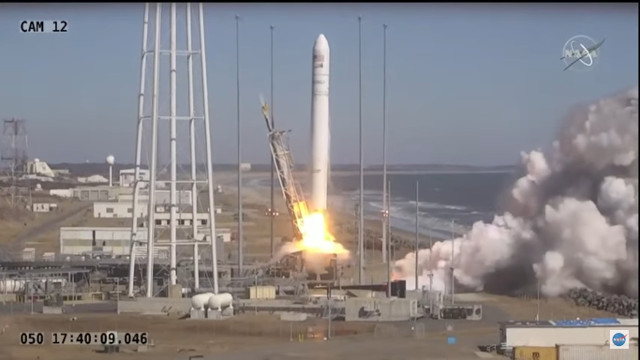
The Cygnus S.S. Ellison Onizuka cargo spacecraft blasting off atop an Antares rocket (Photo NASA’s Wallops Flight Facility/Jamie Adkins)

A few hours ago, Northrop Grumman’s Cygnus spacecraft blasted off atop an Antares rocket from the Mid-Atlantic Regional Spaceport (MARS), part of NASA’s Wallops Flight Facility (WFF) on Wallops Island. After about nine minutes it successfully separated from the rocket’s last stage went en route to its destination. This is its 16th official mission, called NG-16 or CRS NG-16, to transport supplies to the International Space Station for NASA.

The satellites Star One D2 and Eutelsat Quantum blasting off atop an Ariane 5 rocket (Image courtesy Arianespace)

A few hours ago, the telecommunications satellites Star One D2 and Eutelsat Quantum were launched from the Kourou spaceport, in French Guiana, to be sent into a geostationary orbit. Of the two satellites, Eutelsat Quantum was the very special one as it’s the first fully commercial satellite that can be reprogrammed in orbit to respond to changing broadcast needs and upgrade the security of encrypted communications. It has an expected useful life of 15 years.