Launches

Buzz Aldrin photographed by Neil Armstrong, visible in the helmet's reflection (Photo NASA)

On July 20, 1969, NASA’s Apollo 11 mission’s lunar module Eagle, started on July 16, accomplished the first Moon landing of a manned spacecraft. Mission commander Neil Armstrong and lunar module pilot Edwin “Buzz” Aldrin participated in the landing and spent just over two hours on the surface of the Moon to collect some samples that were brought back to Earth. Once they departed the Moon, the two astronauts rejoined Michael Collins, who remained in orbit in the command module Columbia and returned to Earth on July 24th.

The Spektr-RG space telescope blasting off atop a Proton rocket (Image courtesy Roscosmos)

A little more than two hours ago, the Spektr-RG space telescope was launched on a Proton rocket from the Baikonur Cosmodrome, Kazakhstan. After about two hours it separated from the rocket’s upper stage to head towards the L2 Lagrangian point, about 1.5 million kilometers from Earth.

The Spektr-RG (Spektr-Roentgen Gamma, SRG) space telescope is a project born from a collaboration of the Russian Roscosmos and German DLR space agencies for the observation of the X-ray sky. This type of astronomy got a bit crippled by the very premature end of the Japanese Hitomi mission while ESA’s XMM-Newton and NASA’s Chandra space telescopes are still active but these are missions that started twenty years ago.

The Falcon Eye 1 satellite blasting off atop a Vega rocket (Image courtesy Arianespace. All rights reserved)

A few hours ago a Vega rocket was launched from the Kourou base, in French Guiana, to deploy the United Arab Emirates’ Falcon Eye 1 satellite. About two minutes after the launch, immediately after what was supposed to be the second stage’s ignition there was an anomaly that caused the mission’s failure. This is the first failure for the Vega rocket after 14 successes.

SpaceX's Falcon Heavy rocket blasting off in its Space Test Program-2 (STP-2) mission (Photo NASA/Joel Kowsky)

A few hours ago SpaceX launched its Falcon Heavy rocket from Cape Canaveral on a mission involving the launch of various satellites in low and medium Earth orbit. The most powerful rocket in business launched satellites on behalf of NASA, the US Air Force and other entities, incuding CubeSat-class nanosatellites built by students. The mission required four burns for the Falcon Heavy rocket’s upper stage to place them in the various orbits required. The mass of the payloads to be taken into orbit was relatively small – around 3,700 kg – but the second stage needed a lot of fuel to carry out all the maneuvers required in this mission, therefore the initial thrust of the Falcon Heavy was needed.

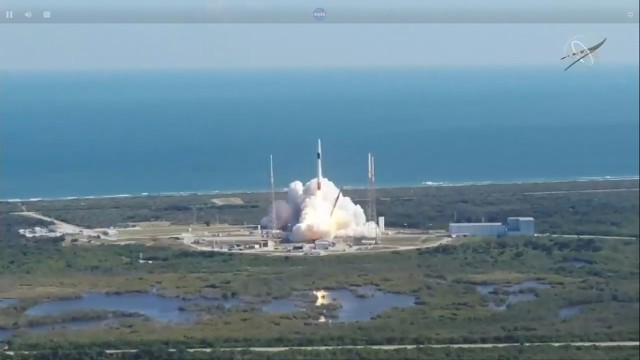
60 Starlink satellites blasting off a Falcon 9 rocket (Image courtesy SpaceX)

A few hours ago 60 satellites of the Starlink constellation were launched on a Falcon 9 rocket from Cape Canaveral. After just over an hour they were successfully deployed into their orbit at an altitude of about 440 kilometers all together and then started slowly disperse. This is SpaceX’s first mission to put the Starlink constellation into orbit to provide a global Internet connection coverage.