Launches

The Crew Dragon Grace spacecraft blasting off atop a Falcon 9 rocket to start its Ax-4 mission (Image NASA)

A little while ago, SpaceX’s Crew Dragon Grace spacecraft was launched atop a Falcon 9 rocket from the Kennedy Space Center on the Axiom Mission 4, or simply Ax-4, mission. After about twelve minutes, it successfully separated from the rocket’s last stage. It will spend up to 14 days in orbit, almost all of which will be docked at the International Space Station. It also serves commercial purposes in a collaboration between SpaceX, Axiom Space, and various companies and national space agencies to access the Station for the purpose of conducting tasks useful for the development of new technologies and for scientific research.

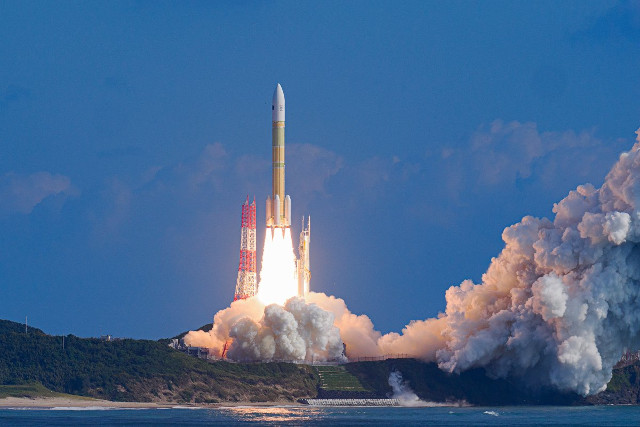
The Tianwen-2 space probe blasting off atop a Long March 3B rocket (Photo courtesy Xinhua/Cai Yang)

A few hours ago, the Tianwen-2 mission was successfully launched. A Long March 3B rocket blasted off from the Xichang Satellite Launch Center, and after about 18 minutes, the space probe separated from the rocket’s last stage to begin its journey towards the asteroid 469219 Kamoʻoalewa. The goal is to collect samples from its surface to bring back to Earth and then resume its journey in space towards the comet 311P/PanSTARRS.

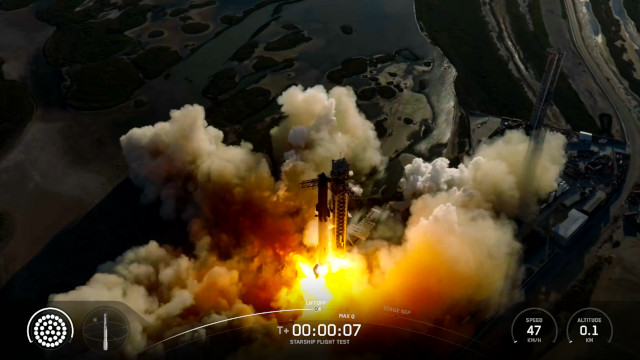
Super Heavy Booster 14 and Starship 35 blasting off (Image courtesy SpaceX)

It was the afternoon in the USA when SpaceX conducted a new flight test of its Super Heavy rocket and Starship prototypes, launched from its base in Boca Chica, Texas. This is the 9th test involving the entire system of Elon Musk’s company, which is supposed to revolutionize space travel with an unprecedented transport capacity and being totally reusable. They are advanced prototypes with the Super Heavy identified as Booster 14, on its second flight in the first reuse of a Super Heavy, and the Starship Block 2 identified as Starship 35 or Ship35 or simply S35.

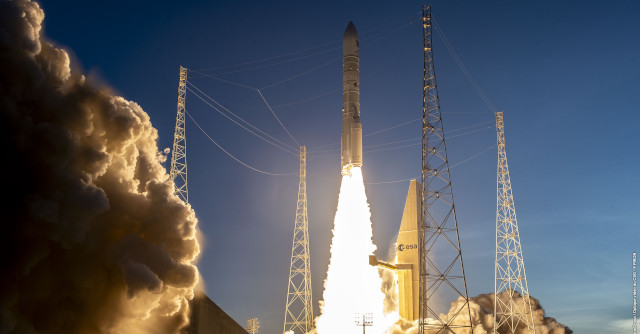
The Biomass satellite blasting off atop a Vega-C rocket (Image courtesy Arianespace)

A little while ago, the Biomass satellite was launched atop a Vega-C rocket from the Kourou base in French Guiana. After about 58 minutes, it successfully separated from the rocket’s last stage and set off on a course that will take it to its Sun-synchronous orbit at an altitude of 666 kilometres, where it will study the biomass of forests around the world. This work will help us better understand the global carbon cycle and forest ecosystems.

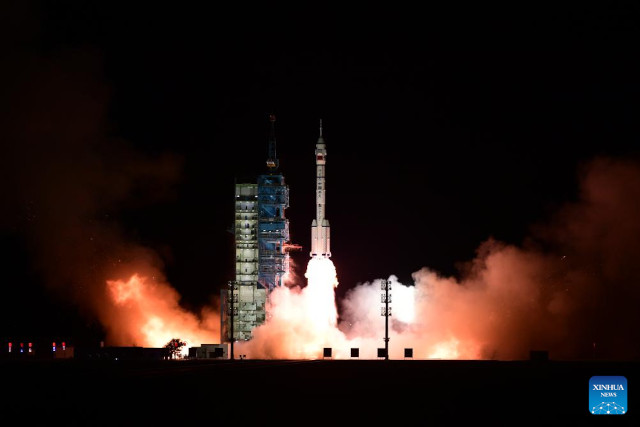
The Shenzhou 20 spacecraft blasting off (Photo courtesy Xinhua/Li Xin)

A confirmation has arrived that three Chinese taikonauts from the Shenzhou 20 mission reached the Chinese space station Tiangong with an automated docking maneuver. They blasted off about 6.5 hours earlier atop a Long March-2F rocket from the Jiuquan Satellite Launch Center. They form the 9th crew of the Chinese space station and will remain there for about six months, the standard duration for a mission.