
Launches

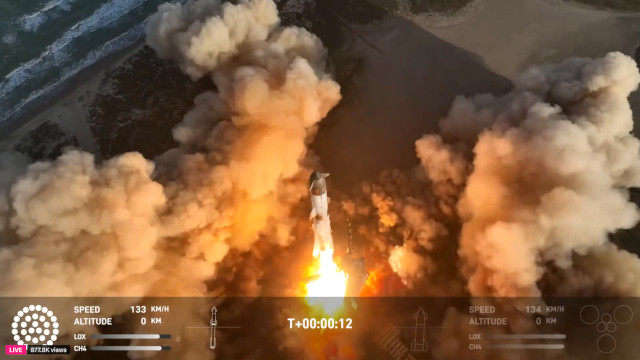
Super Heavy 15 and Starship 34 at liftoff (Image courtesy SpaceX)

It was the afternoon in the USA when SpaceX conducted a new flight test of its Super Heavy rocket and Starship prototypes, launched from its base in Boca Chica, Texas. This is the 8th test involving the entire system of Elon Musk’s company which is supposed to revolutionize space travel with an unprecedented transport capacity and being totally reusable. They are advanced prototypes with the Super Heavy identified as Booster 15 and the Starship Block 2 identified as Starship 34 or Ship34 or simply S34.

The Nova-C Athena Moon lander and the Lunar Trailblazer satellite blasting off atop a Falcon 9 rocket (Image courtesy Intuitive Machines)

A few hours ago, the Nova-C Athena Moon lander blasted off atop a SpaceX Falcon 9 rocket from Kennedy Space Center on Intuitive Machines’ IM-2 mission. After about 48 minutes, it successfully separated from the rocket’s last stage and set off on a course to the Moon, where it’s scheduled to attempt a landing on March 6. About 3 minutes later, NASA’s small Lunar Trailblazer satellite also separated from the rocket’s second stage, but its course is very different from Athena’s, so it will not reach the Moon until June.

Super Heavy Booster 14 and Starship 33 at liftoff (Image courtesy SpaceX)

It was the afternoon in the USA when SpaceX conducted a new flight test of its Super Heavy rocket and Starship prototypes, launched from its base in Boca Chica, Texas. This is the 7th test involving the entire system of Elon Musk’s company which is supposed to revolutionize space travel with an unprecedented transport capacity and being totally reusable. They are advanced prototypes with the Super Heavy identified as Booster 14 and the Starship Block 2 identified as Starship 33 or Ship33 or simply S33.

The New Glenn rocket blasting off in its NG-1 mission (Image courtesy Blue Origin)

A little while ago, Blue Origin’s New Glenn rocket was launched on its maiden mission, called NG-1. For the occasion, it was carrying a prototype of the Blue Ring, a space platform that has the purpose of carrying payloads to be put into orbit, also under development by Blue Origin. The second stage worked correctly and the Blue Ring separated reaching the planned orbit. The secondary objective was to land the first stage, which didn’t succeed.

ispace's Hakuto-R2 Resilience and Firefly Aerospace's Blue Ghost Moon landers blasting off atop a Falcon 9 rocket (Image courtesy SpaceX)

A little while ago, ispace’s Hakuto-R2 Resilience and Firefly Aerospace’s Blue Ghost Moon landers blasted off atop a Falcon 9 rocket from Cape Canaveral. After about 1 hour and 5 minutes, Blue Ghost successfully separated from the rocket’s upper stage, and about 27 minutes later, Resilience separated as well. The two landers will travel on very different routes to attempt to land on the Moon a few months apart. This is ispace’s second mission, after the first failed on April 25, 2023.