Moons

Blogs about any natural satellite.

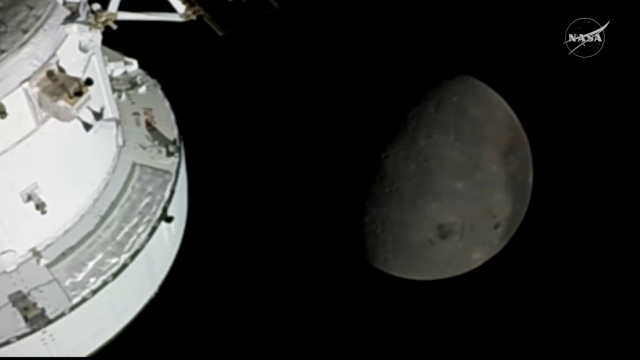
The Orion Integrity spacecraft and the Moon in the background (Image NASA)

NASA’s Orion Integrity spacecraft has completed a record-breaking journey around the Moon as part of the Artemis II mission. It didn’t enter lunar orbit, but “merely” circled it to boldly go where no one has gone before, approximately 406,771 kilometers (252,756 miles) from Earth, breaking the record for the maximum distance for a human spaceflight that was held by Apollo 13. That 1970 mission reminds us of the risks astronauts face in space, and after completing that feat, astronauts Christina Koch, Victor Glover, Reid Wiseman, and Jeremy Hansen set course for their return to Earth, scheduled for Friday, April 10.

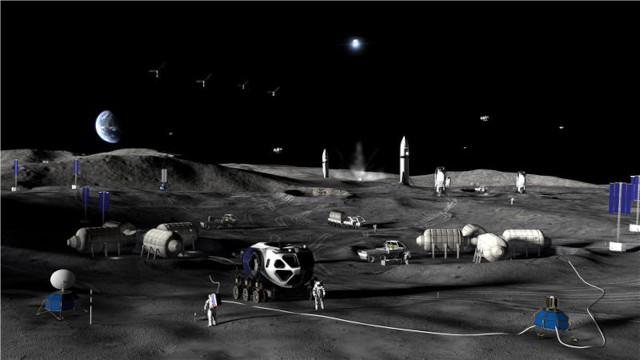
Artist's concept of the Moon base (Image NASA)

Yesterday, NASA held its Ignition event, featuring a series of announcements regarding its space program. Announcements were expected from new Administrator Jared Isaacman and other agency managers in connection with the Artemis program, to clarify the agency’s intentions regarding the return of astronauts to the Moon. From this perspective, the intention that was announced is to accelerate the pace of missions, also in order to build a permanent base on the Moon. In this new vision, the Lunar Gateway project might be abandoned, although officially, it remains relevant in the long term.

The program for missions to Mars was also part of the event. In this case, the Space Reactor-1 Freedom (SR-1 Freedom) mission was introduced, to be conducted using a spacecraft that will use nuclear electric propulsion, scheduled for launch in December 2028. A fleet of Skyfall helicopters is programmed to be on board, intended to continue exploration of the red planet.

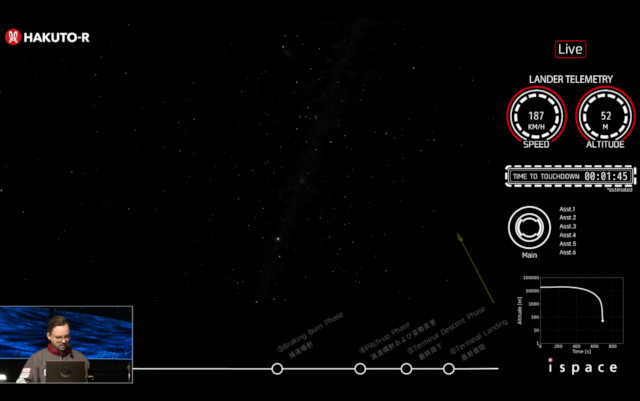
A simulation of the Hakuto-R Resilience lander's trajectory

It was early morning in Tokyo when the Hakuto-R Resilience lander of the Japanese company ispace inc. attempted the Moon landing. For the people who watched the conclusion of the first Hakuto-R lander’s mission, the end of Resilience’s mission unfortunately offered a sense of deja vu. This time, the telemetry transmission was interrupted less than two minutes before the Moon landing, when the speed was measured at 187 km/h at an altitude of 52 meters. This was the so-called Phase 4, during which Resilience was supposed to decelerate. The clear impression is that something went wrong, and this second mission also ended in a crash.

Image captured by Machines’ Nova-C Athena lander during its descent (Image courtesy Intuitive Machines / NASA)

A little while ago, Intuitive Machines’ Nova-C Athena lander attempted its Moon landing in the Mons Mouton area. This was an autonomous maneuver that was the key step in the IM-2 mission. In the minutes following the end of the maneuver, signals started arriving at mission control with increasing clarity. This allowed them to start understanding Athena’s situation.

Graphic representation of the Blue Ghost M1 lander on the Moon (Image courtesy NASA / Firefly Aerospace)

A little while ago, Firefly Aerospace’s Blue Ghost lander attempted a Moon landing in Mare Crisium. This was an autonomous maneuver that was the key step in what is known as Mission 1. After completing its braking and touching down on the Moon’s surface, Blue Ghost sent signals from its sensors confirming its success. After just over half an hour, it started sending images of the Moon’s surface.