Moons

Charon, Nyx and Hydra (Image NASA/JHUAPL/SwRI)

NASA has published a comparative analysis of the spectral measurements of three moons of the dwarf planet Pluto which prove that in particular Nyx but also Hydra have a surface covered in water ice. The New Horizons space probe’s LEISA instrument carried out the measurements during the July 14, 2015 flyby. Unfortunately the location of the other two small moons, Styx and Kerberos in those hours didn’t allow spectral measurements.

The possible scenario of the impact that created the Moon (a) and the following arrival of water (b) (Image Jessica J. Barnes et al.)

An article published in the journal “Nature Communications” describes a research about the water on the Moon and concluded that it was brought mostly by asteroids that struck it between 4.5 and 4.3 billion years ago. Until now, scientists generally thought that water was transported by comets but according to the international team led by Jessica Barnes of the British Open University things are different.

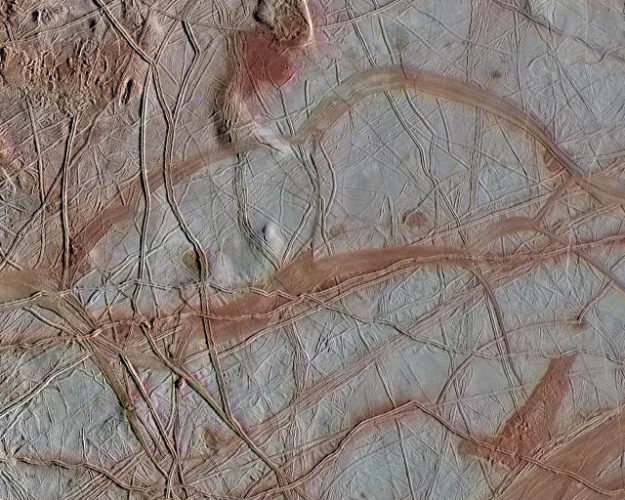
Two different articles, one to be published in the journal “Icarus” and one published in the journal “Monthly Notices of the Royal Astronomical Society”, describe different aspects of a study that offers a new model to describe the tidal effects that might cause fractures on the surface of icy moons. According to a University of Rochester team led by Alice Quillen the tidal effects of a close encounter could explain very extensive fractures.

Europa's surface with its icy crust full of fractures (Photo NASA/JPL-Caltech/SETI Institute)

An article published in the journal “Geophysical Research Letters” describes a research on chemical characteristics existing in the underground ocean of Europa, one of the planet Jupiter’s big moons. A team of scientists at NASA’s Jet Propulsion Laboratory team (JPL) compared the potential to produce hydrogen and oxygen with that of the Earth, concluding that they’re comparable.

The dwarf planet Makemake seen by the Hubble Space Telescope with its moon indicated by the arrow (Image NASA, ESA, and A. Parker and M. Buie (SwRI))

The Hubble Space Telescope has identified a moon of the dwarf planet Makemake. For the moment it was simply designated S/2015 (136472) and nicknamed MK2 and it’s a small moon with an estimated diameter of about 160 kilometers (about 100 miles). The discovery came from observations made in April 2015 using the Hubble’s Wide Field Camera 3 instrument.