Moons

The Nova-C Athena Moon lander and the Lunar Trailblazer satellite blasting off atop a Falcon 9 rocket (Image courtesy Intuitive Machines)

A few hours ago, the Nova-C Athena Moon lander blasted off atop a SpaceX Falcon 9 rocket from Kennedy Space Center on Intuitive Machines’ IM-2 mission. After about 48 minutes, it successfully separated from the rocket’s last stage and set off on a course to the Moon, where it’s scheduled to attempt a landing on March 6. About 3 minutes later, NASA’s small Lunar Trailblazer satellite also separated from the rocket’s second stage, but its course is very different from Athena’s, so it will not reach the Moon until June.

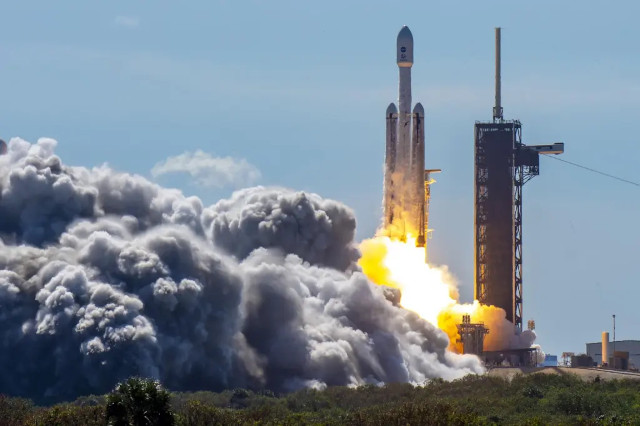
NASA's Europa Clipper space probe blasting off atop a SpaceX Falcon Heavy rocket (Photo NASA)

A few hours ago, NASA’s Europa Clipper space probe blasted off atop a SpaceX Falcon Heavy rocket from the Kennedy Space Center. After just over an hour, it successfully separated from the rocket’s last stage and set off on its route that will take it into deep space, to Europa, Jupiter’s moon with an icy surface that hides an ocean of liquid water to understand if it’s habitable.

The capsule with the samples from the Chang-e 6 mission after landing (Image courtesy CCTV)

A little while ago, the capsule carrying the Moon samples taken during the Chang’e-6 mission landed in the Siziwang Banner, meaning an autonomous county of Inner Mongolia. The lander with the return module landed on the Moon when in China it was June 2, spent about two days collecting samples, and the return module took off to transport the samples to orbit and start the voyage back to Earth. Recovery personnel found the capsule, which will be transported to a laboratory in Beijing, where operations will begin to open it without contaminating its contents.

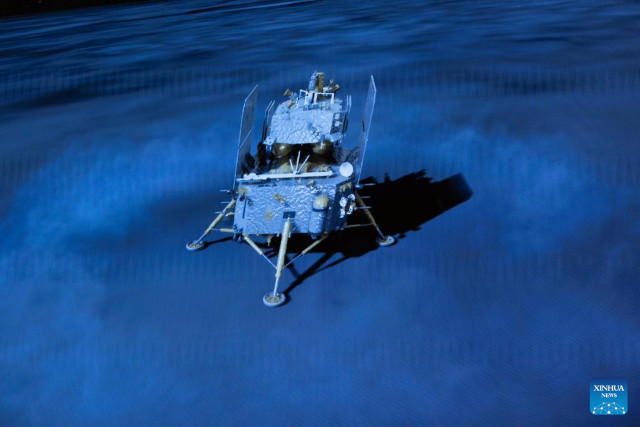
Animation of the lander and ascent module of the Chang'e-6 mission (Image courtesy Xinhua/Jin Liwang)

It was early morning in China when the lander and ascent module of the Chinese Chang’e-6 mission successfully completed their Moon landing maneuvers in the South Pole-Aitken basin area. The various modules that make up Chang’e-6 were launched on May 3 and reached lunar orbit in recent days. At that point, a series of maneuvers began to make the orbit circular, the modules that were supposed to land on the Moon separated and everything went well. In that area, direct communications with Earth are impossible, so contact was maintained using the Queqiao-2 satellite as a relay.

The Chang'e 6 mission's vechicles blasting off (Photo courtesy Xinhua/Guo Cheng)

A few hours ago, the Chang’e 6 mission was successfully launched. A Long March 5 rocket blasted off from the Wenchang space center and after about 36 minutes an orbiter and a lander separated from the rocket’s last stage to begin their journey to the Moon. The aim is to take samples of lunar soil on the far side of the Moon and bring them back to Earth.

The Chang’e 6 mission is a sort of evolution of the previous Chang’e 5, launched on November 23, 2020, which brought lunar samples back to Earth on December 16, 2020. The crucial difference is that in this new mission, the landing of a lander will take place in the South Pole-Aitken basin area, on the far side of the Moon. The choice is due to the fact that there are geological differences between the two faces of the Moon.