Moons

The huge Y-shaped discontinuity on Enceladus' surface (Image NASA/JPL-Caltech/Space Science Institute)

A photograph taken by the Cassini space probe shows a huge system of fractures that have a shape similar to a letter Y on the surface of Enceladus, Saturn’s moon become in recent years one of the most interesting objects of astronomical studies. Called “Y-shaped discontinuities”, these elements of Enceladus’ icy surface are probably relatively young revealing the existing geological activity on this moon.

Titan with Sinlap crater in the pane seen at different wavelengths (Image NASA/JPL-Caltech/University of Arizona/LPGNantes)

At the 47th Lunar and Planetary Science Conference held last week in The Woodlands, Texas, the latest news about the mountains of Titan, the largest of Saturn’s moons, were presented. NASA also presented the progress made in creating maps of this moon, a task that has to face a number of problems. All these works are based on data collected by the Cassini space probe.

Charon's surface and in particular the area called Serenity Chasma (Image NASA/JHUAPL/SwRI)

The analysis of the photographs of Charon, the largest of Pluto’s moons, suggests that once it had an underground ocean that at some point froze causing the expansion of its surface layer. That event could explain the presence of a very long fracture on its surface, a kind of huge scar that devastates its equator.

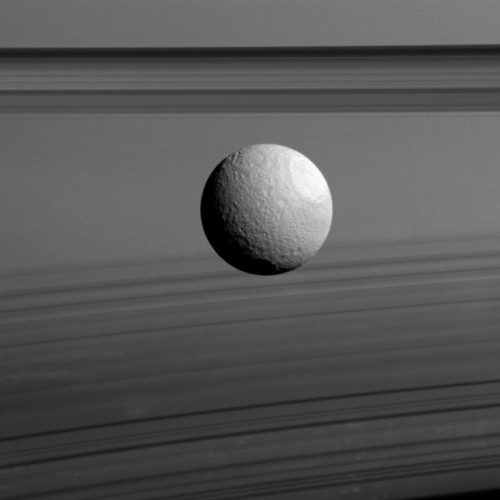
Saturn's moon Tethys with the planet's rings in the background (Image NASA/JPL-Caltech/Space Science Institute)

NASA has published a photograph taken by the Cassini space probe that frames Tethys, one of Saturn’s moons, in front of the planet’s rings. They have such a relative position Tethys seems to float between two sets of rings but it’s just an optical effect. The result is a particularly striking image even by the standards of a mission that has been offering stunning portraits of the planet Saturn, its rings and its moons.

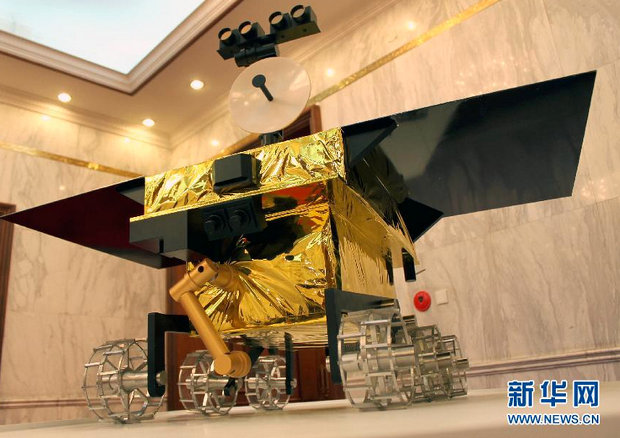
The Yutu, which means Jade Rabbit, lunar rover (Photo courtesy news.cn. All rights reserved)

An article published in the journal “Nature Communications” describes the discovery of a new type of rock on the Moon, precisely in Mare Imbrium. It was possible thanks to the data collected by the Chinese Yutu rover during its Chang’e 3 mission. In a crater called Zi Wei, Yutu found a type of basalt with a composition different from those collected in past decades during the American and Soviet Moon missions.