Moons

Photo of Enceladus' northern region showing the contrast between its areas (Image NASA/JPL-Caltech/Space Science Institute)

Some days ago, the Cassini space probe completed its last Enceladus flyby. It’s a Saturn’s moon very interesting for the presence of an underground ocean of liquid water. This time, Cassini passed about 5,000 kilometers (about 3,100 miles) from Enceladus measuring the heat flow from inside it and taking more pictures of its icy surface.

Images of Pluto's surface (Image NASA/JHUAPL/SwRI)

NASA released images of the dwarf planet Pluto and its main moon Charon showing most of their surface. They’re formed by compositions of various photographs taken by two cameras of the New Horizons space probe: the Long Range Reconnaissance Imager (LORRI) and the Ralph/Multispectral Visible Imaging Camera. The photographs were taken between July 7 and 13, during the approach that led to the extraordinary July 14, 2015 flyby.

Pictures of Phobos showing the grooves on its surface (Photo NASA/JPL-Caltech/University of Arizona)

At the 47th Annual Meeting of the American Astronomical Society’s Division for Planetary Sciences in National Harbor, Maryland, A research was presented about Phobos, a moon of Mars. Terry Hurford of NASA’s Goddard Space Flight Center led a team of scientists who analyzed the grooves on Phobos surface. The conclusion is that these are the first signs of structural failure that will lead to the destruction of this moon.

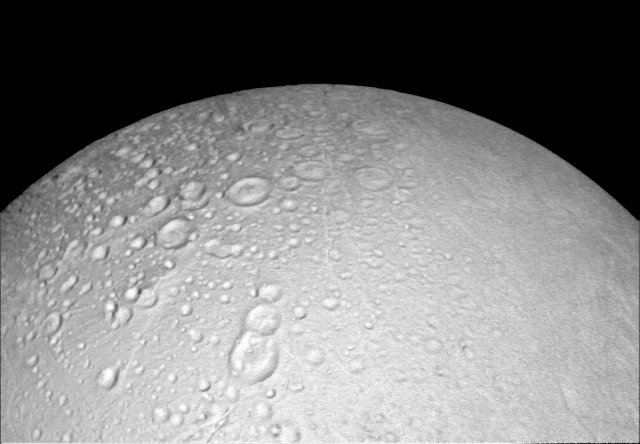
The area around Enceladus north pole with its many craters photographed by the Cassini space probe (Photo NASA/JPL-Caltech/Space Science Institute)

In recent days, the Cassini spacecraft made one of the closesest flybys with Enceladus, one of Saturn’s moons, passing at a distance of about 1,840 kilometers (almost 1,140 miles) from its surface. The first pictures received at the mission control center show that Enceladus north pole has many fractures in the ice crust that covers this moon but there are also thin cracks running through it and many craters around it.

Picture of Charon take by NASA's New Horizons space probe (Image NASA/JHUAPL/SwRI)

If the images of the dwarf planet Pluto published by NASA in recent months haven’t been enough for you, now high-resolution photos of Charon, its largest moon, have been released. The first images arrived soon after the New Horizons space probe’s July 14, 2015 flyby had already shown a moon with a complex geology. These new images show even better the deep chasms that ply its equator and the curious color of its north pole.