Moons

Io as seen by the Juno space probe (Image NASA/JPL-Caltech/SwRI/MSSS. Image processing: Gerald Eichstädt/Thomas Thomopoulos (CC BY))

At the European Geophysical Union General Assembly held in Vienna last week, NASA’s Juno mission principal investigator Scott Bolton illustrated some new discoveries offered by the Juno space probe, including some regarding Io, Jupiter’s volcano-covered moon. Io was also studied by a team of researchers who used the ALMA radio telescope to map the movements of sulfur isotopes and reconstruct the tidal heating that generates the intense volcanic activity. The results were published in an article in the journal “Journal of Geophysical Research: Planets”.

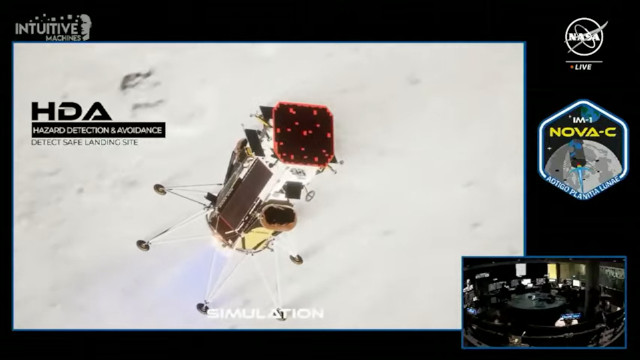
A simulation of Odysseus Moon landing (Image courtesy Intuitive Machines / NASA TV)

It was the afternoon in the USA when Intuitive Machines’ Nova-C Odysseus lander attempted its Moon landing in the Malapert A crater. It was an autonomous maneuver that constituted the crucial step of the IM-1 mission. It took about 10 minutes to receive the first faint signals from Odysseus but they were invaluable in confirming the Moon landing. At Intuitive Machines’ mission control center, work began to have regular communications that allow them to understand Odysseus’ exact status and receive the data collected, including images.

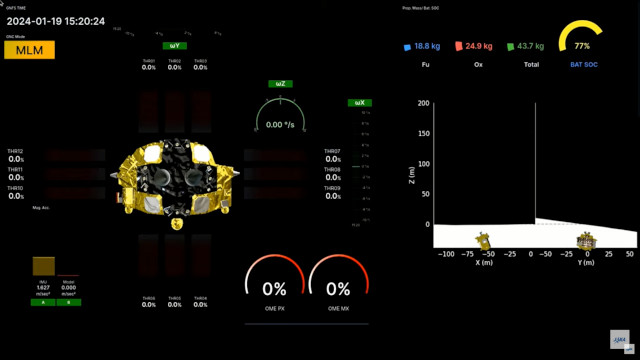
Image from the SLIM lander Moon landing simulation

It was the night between Friday and Saturday in Japan when the Japanese space agency JAXA’s SLIM lander attempted to land on the Moon but things got complicated. Only after a couple of hours, a press conference was held in which it was announced that the Moon landing was successful but there were some problems that could shorten the mission if SLIM fails to recharge its batteries. Meanwhile, Japan has become the fifth nation to put a robotic vehicle on the Moon.

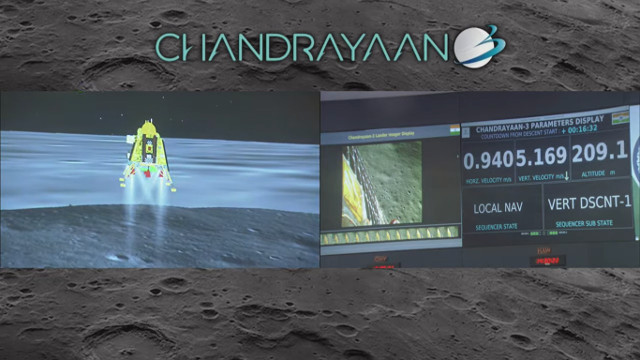
Animation of the Vikram lander and the Pragyan rover during the moon landing (on the left) and the real situation (on the right) (Image courtesy ISRO)

The Vikram lander and the Pragyan rover of the Indian mission Chandrayaan 3, launched on July 14, have successfully landed on the Moon. The idea at the Indian space agency ISRO was to replicate what was done almost exactly four years ago in the Chandrayaan 2 mission, eliminating the problems encountered on that occasion in order to achieve success. The hard lesson was learned and this time, the vehicles successfully completed the insidious maneuver of landing on the Moon. India joins the small club of nations that successfully sent a vehicle to the Moon.