Moons

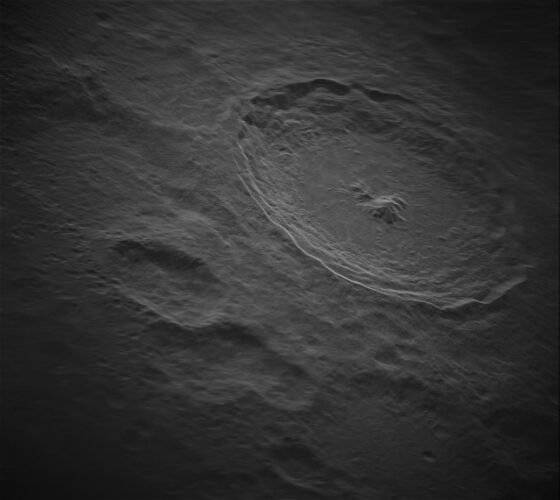
Radar image of Tycho Crater on the Moon (Image NRAO/AUI/NSF)

A new image of Tycho’s crater on the Moon is the most detailed yet captured from Earth. A collaboration between Green Bank Observatory (GBO), National Radio Astronomy Observatory (NRAO), Raytheon Intelligence & Space (RI&S), and Green Bank Telescope (GBT) produced the image thanks to a new radar technology that greatly improved astronomical applications of radars. Images of the lunar surface are just the beginning because other objects can be examined to create far more detailed images than radars could before. This result can be achieved with low-power radar transmitters.

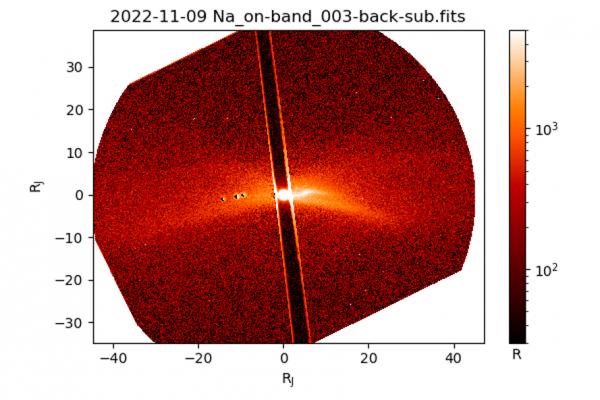
An image captured by the IoIO instrument on November 9, 2022, showing the sodium nebula emissions from the outburst originating from Io

A violent volcanic outburst was detected on Jupiter’s moon Io by Jeff Morgenthaler using the Io Input/Output observatory (IoIO) at the Planetary Science Institute (PSI). The scientist of this non-profit organization based in Arizona has been monitoring Io since 2017, observing several outbursts but the one in autumn 2022 was the most violent. This monitoring can also be useful for the mission of NASA’s Juno space probe, in orbit around Jupiter, as NASA is planning a Io flyby in December 2023 in which its instruments will be able to carry out measurements of the emitted gases such as sodium and ionized sulfur.

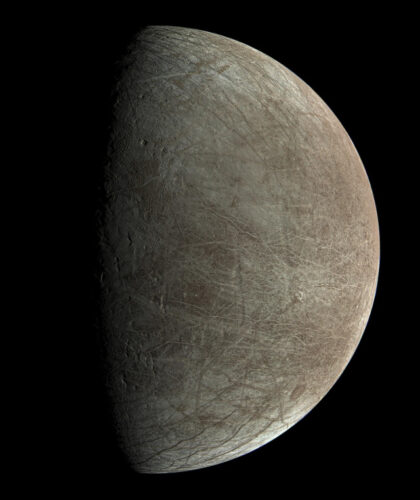
Europa seen by the Juno space probe (Image data: NASA/JPL-Caltech/SwRI/MSSSImage processing by Björn Jónsson)

NASA has released images of Europa, one of Jupiter’s so-called Galilean satellites, captured by its Juno space probe during a flyby conducted on September 29. The JunoCam was the main instrument for this task but for the occasion, a close-up shot was also captured by the SRU (Stellar Reference Unit), an instrument generally used to orient Juno by observing the stars. The photos taken by JunoCam were processed by some of the so-called citizen scientists, amateurs who contribute following their personal passion.

Neptune, its rings and some of its moons as seen by the James Webb Space Telescope (Image NASA, ESA, CSA, STScI. Image processing: Joseph DePasquale (STScI))

Images of Neptune captured by the James Webb Space Telescope show details of the planet and its rings with a clarity comparable only to those taken in 1989 by NASA’s Voyager 2 space probe during a planet flyby. The observations made it possible to capture details of many storms existing in Neptune’s atmosphere, including the Great Dark Spot. Webb also photographed Triton and six of the smaller moons.

Jupiter seen through three filters applied to the James Webb Space Telescope's NIRCam (Near-Infrared Camera) instrument

NASA has published some photos of Jupiter captured by the James Webb Space Telescope that offer new information on the processes taking place within the largest planet in the solar system. The combination of different infrared filters leads to various results that allow appreciating new details of Jupiter. The colors are different from the real ones precisely because Webb detected them using infrared filters but the results are very interesting for the information they offer on storms, auroras, and various processes taking place on the planet and within it. Some images also include its rings and some of its moons.