Moons

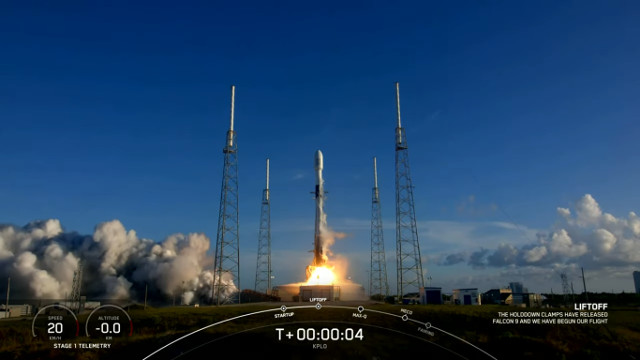
The Danuri space probe blasting off atop a Falcon 9 rocket (Image courtesy SpaceX)

A few hours ago the Korea Pathfinder Lunar Orbiter (KPLO) space probe, which recently received the official name Danuri, blasted off atop a SpaceX Falcon 9 rocket from Cape Canaveral. After just over 40 minutes, it successfully separated from the rocket’s last stage and began the series of maneuvers that will take it into the Moon’s orbit. It’s a long journey planned using what is technically called Ballistic Lunar Transfer (BLT) to optimize efficiency and save the onboard fuel. This means that it will enter the Moon’s orbit only on December 16. If everything works well, Danuri will begin its one-year scientific mission in which its instruments will conduct various surveys.

A lunar pit in the Mare Tranquillitatis on the Moon

An article published in the journal “Geophysical Research Letters” reports a study on some lunar pits where temperatures are stable at around 17° Celsius (about 290 Kelvin). A team of researchers led by UCLA’s Tyler Horvath used detections conducted with NASA’s Lunar Reconnaissance Orbiter (LRO) space probe’s Diviner Lunar Radiometer Experiment, or simply Diviner, instrument and computer simulations to assess the conditions that exist in particular in lunar pits. The discoveries are interesting in the search for the best places on the Moon to build human habitats.

Artist's concept of the exoplanet Kepler-1708 b with its moon (Image courtesy Helena Valenzuela Widerström)

An article published in the journal “Nature Astronomy” reports the discovery of an exomoon candidate that was cataloged as Kepler-1708 b-i. A team of researchers led by David Kipping of Columbia University analyzed data collected by NASA’s Kepler Space Telescope with the specific purpose of looking for possible moons around exoplanets discovered thanks to Kepler. The Jupiter-sized gas giant Kepler-1708 b has a signal indicating the possible presence of a moon that would be a little smaller than the planet Neptune.

Infographic of water vapor's presence in Europa's atmosphere (Image ESA/Hubble, J. da Silva)

An article published in the journal “Geophysical Research Letters” reports the detection of a stable presence of water vapor in the atmosphere of Jupiter’s moon Europa. Lorenz Roth of the Kth Royal Institute of Technology in Stockholm, Sweden, used ultraviolet observations conducted with the Hubble Space Telescope between 1999 and 2015 to infer the presence of water vapor. Its presence appears to be persistent only in one hemisphere of Europa, the one opposite the moon’s direction of motion in its orbit.

The PDS 70 system with the zoom on the protoplanet PDS 70 c

An article published in “The Astrophysical Journal Letters” reports a study on the circumplanetary disk around the exoplanet PDS 70 c. A team of researchers led by Myriam Benisty used the ALMA radio telescope to study what is still a protoplanet and the disk of materials around it that could form moons. According to estimates, there’s enough mass to form up to three moons the size of the Earth’s Moon. This type of study offers new information both on the formation of planets, especially gas giants, and on moons, one of the frontiers astronomers are trying to open.