NASA

Artistic representation of the Voyager 1 space probe in deep space (Image NASA/JPL-Caltech)

An article published in “Astrophysical Journal Letters” describes a new analysis of the data collected by NASA’s Voyager 1 space probe to understand why certain detections were abnormal. Voyager 1 entered interstellar space in 2012 but the unclear data raised discussions. After about a year, NASA confirmed the event but some unexpected characteristics of the solar system borders required further studies.

The galaxy cluster MACS J0416.1–2403 observed by the Hubble Space Telescope (Image NASA, ESA and the HST Frontier Fields team (STScI))

An international team led by the astronomer Hakim Atek of the Ecole Polytechnique Fédérale de Lausanne, Switzerland, used the Hubble Space Telescope to observe over 250 dwarf galaxies that existed between 600 and 900 million years after the Big Bang. It’s one of the largest samples of dwarf galaxies discovered so far dating back to such a remote era and allows us to look into the universe at a young age providing useful information to understand its evolution.

Artist's impression of innumerable Earth-like planets that have yet to be born (Image NASA, ESA, and G. Bacon (STScI))

An article just published in the journal “Monthly Notices of the Royal Astronomical Society” describes a research on the history and future of the formation of Earth-like planets. A team led by Peter Behroozi of the Space Telescope Science Institute (STScI) used data collected by the Hubble and Kepler space telescopes to evaluate the rate of formation of the Earth-like planets. The conclusion is that only 8% of potentially habitable planets existed at the birth of our solar system.

The area around Enceladus north pole with its many craters photographed by the Cassini space probe (Photo NASA/JPL-Caltech/Space Science Institute)

In recent days, the Cassini spacecraft made one of the closesest flybys with Enceladus, one of Saturn’s moons, passing at a distance of about 1,840 kilometers (almost 1,140 miles) from its surface. The first pictures received at the mission control center show that Enceladus north pole has many fractures in the ice crust that covers this moon but there are also thin cracks running through it and many craters around it.

High-resolution picture of Pluto. In the upper right a part of the heart-shaped area (Photo NASA/JHUAPL/SwRI)

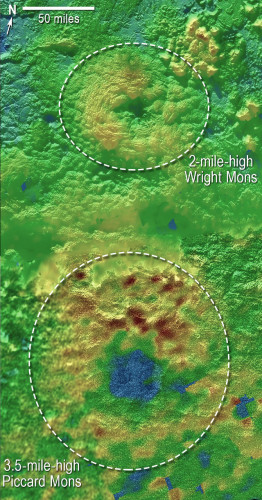
The journal “Science” just published the first article on the findings on the dwarf planet Pluto and its moons made thanks to NASA’s New Horizons spacecraft July 14, 2015 flyby. Alan Stern of the Southwest Research Institute (SwRI), the principal investigator of the New Horizons mission, is also the first of a long series of authors of this study that first of all stresses the extraordinary geological and morphological variety of Pluto’s system.