NASA

Map-projected view of the dwarf planet Ceres (Image NASA/JPL-Caltech/UCLA/MPS/DLR/IDA)

The mysteries of the dwarf planet Ceres are a topic of discussion at the European Planetary Science Congress going on these days in Nantes, France. For the occasion, NASA published new topographic maps of Ceres based on data collected by its Dawn space probe, which has been mapping it for a few weeks. The latest news on this dwarf planet came from some emission of energetic electrons.

Image of narrow streaks of water on Martian slopes at Hale Crater (Image NASA/JPL-Caltech/Univ. of Arizona)

Yesterday NASA announced the existence of flows of liquid water on Mars. The study, just published in the journal “Nature Geoscience”, is based upon years of analysis of data collected mainly thanks to the NASA’s MRO (Mars Reconnaissance Orbiter) space probe. The images captured by its camera and spectrometric data allowed to find streams of water along the walls of craters and slopes that vary over time and perchlorate salts in them.

The snakeskin area called Tartarus Dorsa on Pluto's surface (Image NASA/JHUAPL/SWRI)

After more than two months since the extraordinary Pluto flyby of NASA’s New Horizons space probe some people might think that the data arrived to Earth are enough to know this dwarf planet comprehensively. Reality keeps on being very different on this small world frozen yet as varied as you would expect from a geologically active planet with an atmosphere that can erode its soil. Here then is the image of a “snakeskin” surface that again leaves scientists puzzled and surprised.

Mountains and the layers of the atmosphere on Pluto (Photo NASA/JHUAPL/SwRI)

The latest images of Pluto just published by NASA show new details of this dwarf planet. So far, the photographs were usually taken from the New Horizons space probe’s LORRI camera, instead these ones were taken by MVIC (Multispectral Visible Imaging Camera), one of the components of the Ralph small telescope that’s part of probe’s payload. These pictures show in an extraordinary way mountains, glaciers and the hazy layers of Pluto’s atmosphere.

Artistic representation of the interior of Enceladus with a global underground ocean (Image NASA/JPL-Caltech)

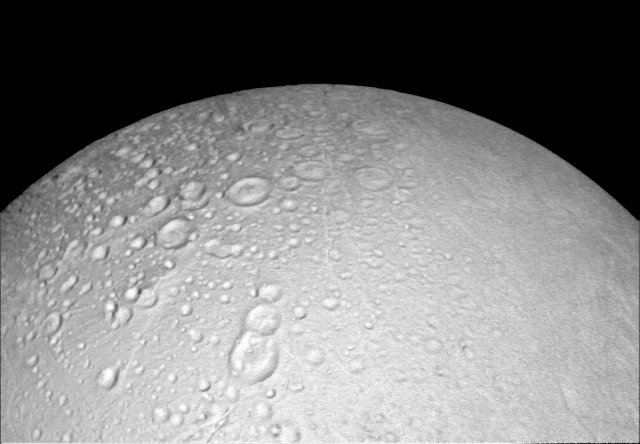
An article just published in the journal “Icarus” describes a research that used data collected by the Cassini space probe to determine that Enceladus, one of Saturn’s moons, has a global underground ocean. That there was an ocean beneath the icy surface of Enceladus was a well-established fact from previous research but it remained to be seen whether the water was liquid all over beneath the surface or only in some warm enough areas.