NASA

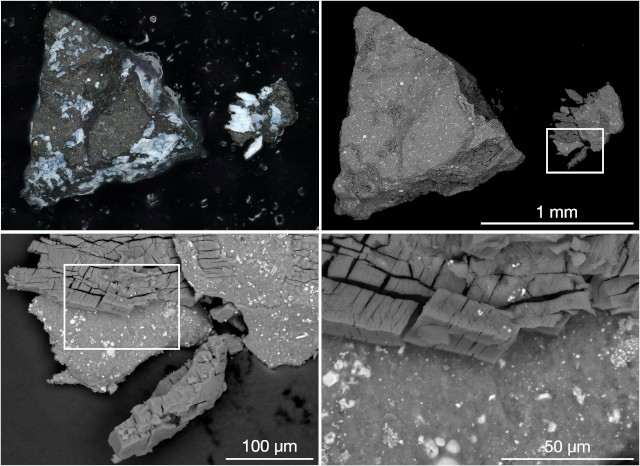
At the top left a sample taken from the asteroid Bennu and in the subsequent panels increasingly zoomed views of a fragment that broke off along a bright vein that contains phosphate, captured under an electron microscope

An article published in the journal “Meteoritics & Planetary Science” reports the results of the preliminary analysis of the samples of material from asteroid Bennu brought back to Earth by NASA’s OSIRIS-REx space probe. A team of researchers conducted morphological and chemical analyzes of the samples, finding a lot of carbon and nitrogen together with organic compounds, all very important components for life forms of the Earth’s type.

The surprise came from the discovery of magnesium-sodium phosphate, which wasn’t detected by the instruments aboard OSIRIS-REx. This compound forms in water-rich environments and suggests that Bennu may be a fragment of a primordial world that had an ocean. The researchers mentioned Enceladus, Saturn’s moon with a subterranean ocean where sodium phosphate was found, and suggest a possible link to Bennu.

The Dragon cargo spacecraft departing the International Space Station to end its CRS-30 mission (Image NASA TV)

A few hours ago, SpaceX’s Dragon spacecraft ended its CRS-30 (Cargo Resupply Service 30) mission for NASA splashing down smoothly off the Florida Coast. The Dragon left the International Space Station a little more than 36 hours earlier. For SpaceX, this was the 10th mission of the 2nd contract with NASA to transport supplies to the Station with the new version of the Dragon cargo spacecraft.

Shortly after the splashdown, SpaceX’s recovery ship went to retrieve the Dragon to transport it to the coast. The cargo brought back to Earth will be delivered to NASA within a few hours. The Dragon spacecraft reached the International Space Station on March 23, 2024.

The Soyuz MS-24 spacecraft surrounded by the support crew (Image NASA TV)

A little while ago, cosmonauts Oleg Novitsky and Marina Vasilevskaya and astronaut Loral O’Hara returned to Earth on the Soyuz MS-24 spacecraft, which landed in Kazakhstan. Novitsky completed a one-year mission on the International Space Station, Vasilevskaya was a visitor who stayed on the Station for a few days while O’Hara spent a bit more than 6 months on the Station.

The Soyuz MS-25 spacecraft approaching the International Space Station (Image NASA TV)

A little while ago the Soyuz MS-25 spacecraft, which blasted off about two days ago from the Baikonur Cosmodrome in Kazakhstan, has reached the International Space Station carrying one new crew member and two visitors. Astronaut Tracy Dyson of NASA is part of Expedition 70/71 while cosmonaut Oleg Novitskiy of Roscosmos and the Belarusian Marina Vasilevskaya will remain on the Station for a few days.