NASA

A Falcon 9 rocket lifting off on the Twilight rideshare mission (Image courtesy SpaceX)

A few hours ago, a Falcon 9 rocket launched from Vandenberg Air Force Base on the Twilight rideshare mission, carrying a total of 40 satellites in various phases. About two hours and twenty minutes after launch, the final group of satellites was deployed by SpaceX’s system. Among them were NASA’s Pandora Space Telescope and the BlackCAT and SPARCS nanosatellites, both 30x20x10-centimeter CubeSat-class satellites, part of NASA’s CubeSat Launch Initiative. These satellites will conduct their astronomical observations from low-Earth orbit.

The complete map obtained thanks to the SPHEREx space telescope, with infrared emissions generated mainly by dust (red) and hot gas (blue), key ingredients in the formation of new stars and planets

NASA has published the first cosmic map generated using observations from its SPHEREx space telescope. In particular, these observations include 102 wavelengths in the near-infrared. What NASA has defined as 102 colors offer a wealth of different information about the observed objects, valuable in a variety of cosmological studies. The wealth of information is such that NASA treats them as if they had obtained 102 different maps.

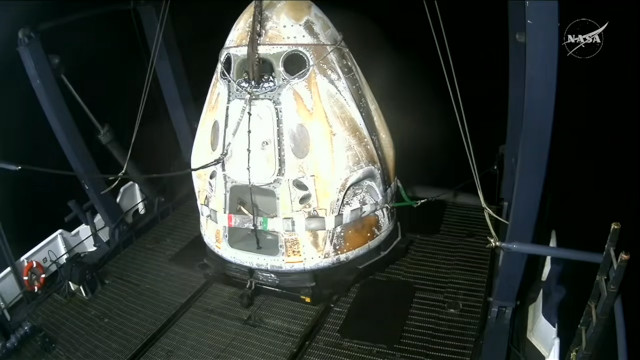
The capsule of the Soyuz MS-27 spacecraft after landing (Image NASA+)

A few hours ago, cosmonauts Sergey Ryzhikov and Alexey Zubritsky and astronaut Jonny Kim returned to Earth on the Soyuz MS-27 spacecraft, which landed in Kazakhstan. They had reached the International Space Station on April 8, 2025, as part of a normal crew rotation. The capsule landed on its side, an event that can occur due to reentry conditions, but the crew members suffered no injuries.

The crew of the Soyuz MS-28 spacecraft: Chris Williams, Sergey Kud-Sverchkov, and Sergey Mikaev (Photo courtesy of GCTC)

A few hours ago, the Soyuz MS-28 spacecraft was launched from the Baikonur Cosmodrome in Kazakhstan and, after a little more than three hours, reached the International Space Station with three new crew members on board. It docked with the Station’s Rassvet module. The ultra-fast track was used, which halves the journey duration and is used whenever the Station’s position makes it possible.

The Sentinel-6B satellite blasting off atop a Falcon 9 rocket (Image courtesy SpaceX)

A few hours ago, the Sentinel-6B satellite was launched atop a Falcon 9 rocket from the Vandenberg base. After about 57 minutes, it successfully separated from the rocket’s last stage and set off on its course to reach the polar orbit at 1,336 kilometers altitude where its scientific mission will begin, taking over from the Sentinel-6A Michael Freilich satellite, which was launched on November 21, 2020.