NASA

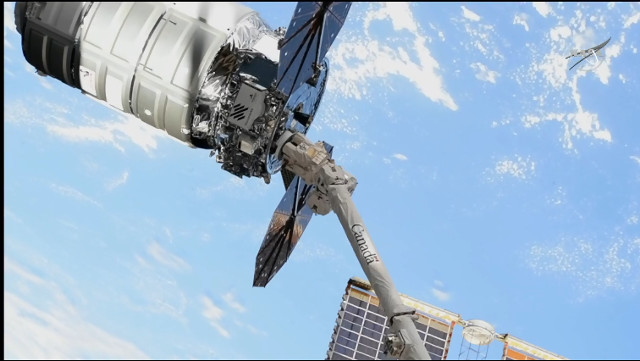
The Cygnus S.S. Piers Sellers cargo spacecraft captured by the Canadarm2 robotic arm (Image NASA TV)

Northrop Grumman’s Cygnus spacecraft, launched last Saturday, February 19, has just reached the International Space Station and was captured by the Canadarm2 robotic arm. Astronaut Raja Chari, assisted by his colleague Kayla Barron, will soon begin the slow maneuver to move the Cygnus until it docks with the Station’s Unity module after about two hours.

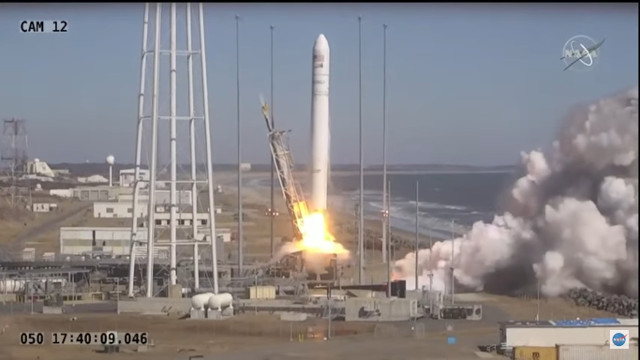
The Cygnus S.S. Piers Sellers cargo spacecraft blasting off atop an Antares rocket (Image NASA TV)

A little while ago, Northrop Grumman’s Cygnus spacecraft blasted off atop an Antares rocket from the Mid-Atlantic Regional Spaceport (MARS), part of NASA’s Wallops Flight Facility (WFF) on Wallops Island. After about nine minutes it successfully separated from the rocket’s last stage went en route to its destination. This is its 17th official mission, called NG-17 or CRS NG-17, to transport supplies to the International Space Station for NASA.

The Dragon cargo spacecraft departing the International Space Station to end its CRS-24 mission (Image NASA)

Yesterday, in the American afternoon, SpaceX’s Dragon spacecraft ended its CRS-24 (Cargo Resupply Service 24) mission for NASA splashing down smoothly in the Gulf of Mexico, near Panama City. The Dragon left the International Space Station last Sunday. For SpaceX, this was the 4th mission of the 2nd contract with NASA to transport supplies to the Station with the new version of the Dragon cargo spacecraft, which splashes down near the East coast of the USA instead of the Pacific Ocean.

Shortly after the splashdown, SpaceX’s “Go Searcher” recovery ship went to retrieve the Dragon to transport it to the coast. The cargo brought back to Earth will be delivered to NASA within a few hours. The Dragon spacecraft reached the International Space Station on December 22, 2021.

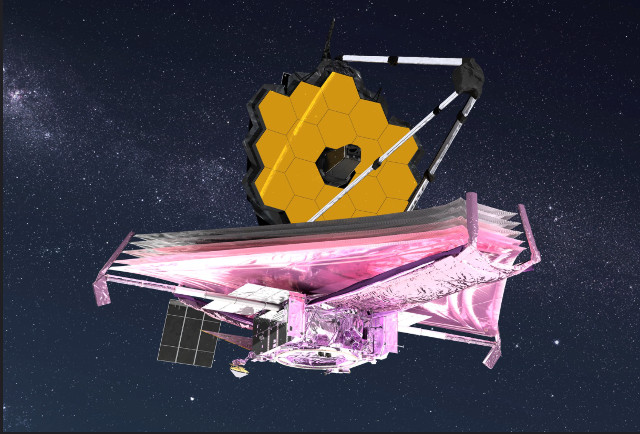
Illustration of the James Webb Space Telescope (Image NASA GSFC/CIL/Adriana Manrique Gutierrez)

Yesterday, NASA confirmed the successful completion of the deployment of all components of the James Webb Space Telescope. Launched on December 25, 2021, this next-generation space telescope required several days of complex operations to deploy the various structures that make it up to reach its final configuration. This was a crucial phase that also included risks in the event that one of the systems didn’t work properly. Now the new phase opens with the calibration of the instruments, task-intensive to the point that it will take months before the James Webb can finally begin its scientific mission.

The James Webb Space Telescope blasting off atop an Ariane 5 ECA rocket (Image NASA TV)

A little while ago, the James Webb Space Telescope was launched atop an Ariane 5 ECA rocket from the Kourou base, French Guiana. After about 27 minutes it successfully separated from the rocket’s last stage and began its journey to the area known as L2, about 1.5 million kilometers from Earth. During the journey, its structure will be deployed and instrument tests and calibrations will begin. That’s a long preparation phase that will continue even after the telescope has reached its destination. The launch has put a strain on the possibilities of one of the most powerful and reliable rockets available but was only the first in a series of critical steps required to begin the work of this extremely sophisticated instrument.