NASA

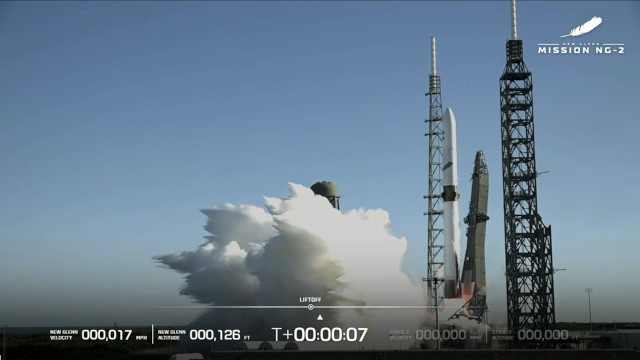
The ESCAPADE twin probes blasting off atop a New Glenn rocket (Image courtesy Blue Origin)

A few hours ago, NASA’s ESCAPADE (Escape and Plasma Acceleration and Dynamics Explorers) twin probes were launched atop a Blue Origin New Glenn rocket, which accomplished its mission, called NG-2. One goal for Blue Origin was to land the first stage, which was a successful one just over 9 minutes after launch. After approximately 33 minutes, the probes, named Blue and Gold, separated from the rocket’s second stage and began a long journey to Mars to study its magnetosphere and the Sun’s impact on the red planet.

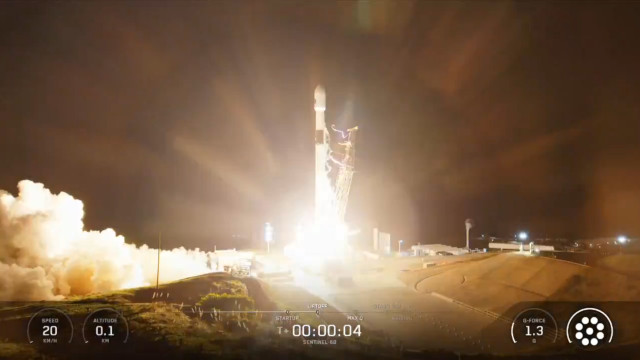
The Carruthers Geocorona Observatory, IMAP (Interstellar Mapping and Acceleration Probe), and Space Weather Follow On-Lagrange 1 (SWFO-L1) space probe blasting off atop a Falcon 9 rocket (Image NASA+)

A little while ago, three space probes were launched atop a Falcon 9 rocket from the Kennedy Space Center. After approximately one hour and 23 minutes, they successfully separated from the rocket’s final stage within about 13 minutes and set off on a course that will take them to the area known as L1 (Lagrange 1), about 1.5 million kilometers from Earth, where they will begin their scientific work studying various aspects of space weather.

the Cygnus XL cargo spacecraft captured by the International Space Station's Canadarm2 robotic arm (Image NASA+)

Northrop Grumman’s Cygnus XL spacecraft, launched last Monday, September 15, has just reached the International Space Station and was captured by the Canadarm2 robotic arm. Astronaut Jonny Kim, assisted by his colleague Zena Cardman, will soon begin the slow maneuver to move the Cygnus until it docks with the Station’s Unity module after about two hours.

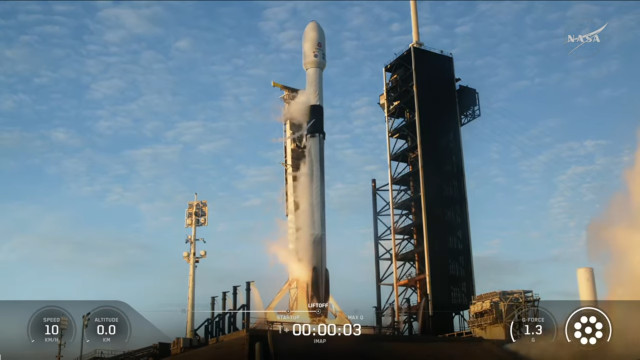
Northrop Grumman's Cygnus XL cargo spacecraft blasting off atop a SpaceX Falcon 9 rocket (Image NASA+)

A few hours ago, Northrop Grumman’s Cygnus XL spacecraft blasted off atop a SpaceX Falcon 9 rocket from Cape Canaveral on its NG-23 or CRS NG-23 mission. After about 15 minutes, it successfully separated from the rocket’s last stage and set on its course. This is the third resupply mission to the International Space Station with various payloads launched using the Falcon 9 rocket while waiting for the new version of Northrop Grumman’s Antares rocket to be ready. It’s also the first to see the use of the new version of the Cygnus cargo spacecraft.

Some views of the rock Cheyava Falls with spectroscopic results (d) from the examination of samples from the area

An article published in the journal “Nature” reports the results of the analysis of data collected by NASA’s Mars Rover Perseverance on the rock nicknamed Cheyava Falls. Perseverance found it in 2024 in the Neretva Valley during its journey within the Jezero Crater on Mars. The rock immediately attracted great interest because it contains chemical signatures and structures that could have been generated by ancient Martian life forms.

A team of researchers confirmed the exciting results presented last year and concluded that these are potential biosignatures. This means they provide clues to the possible presence of Martian life forms in the past, but further studies are needed to obtain definitive answers. In fact, the presence of organic compounds and iron minerals such as vivianite and greigite could also be due to abiotic reactions.