NASA

A NASA diagram of the PWS instrument's location and the antenna in common with the PRA instrument

An article published in the journal “Nature Astronomy” reports a study on the faint interstellar plasma waves detected by NASA’s Voyager 1 space probe. A team of researchers led by Stella Koch Ocker of Cornell University used a series of detections conducted by Voyager 1 while traveling a total distance that is about ten times the average distance of the Earth from the Sun which gives an idea of ​​the characteristics of the interstellar plasma when it’s not altered by events related to solar activity.

The OSIRIS-REx space probe being prepared (Photo NASA/Dimitri Gerondidakis)

NASA has confirmed that its OSIRIS-REx space probe has left the asteroid Bennu after more than two years of study. In fact, OSIRIS-REx reached Bennu on December 3, 2018. In addition to the data collected with its instruments, OSIRIS-REx will bring back to Earth a capsule containing the Bennu samples collected on October 20, 2020. The return journey will be long because the arrival is scheduled for September 24, 2023.

SpaceX's Crew Dragon Resilience spacecraft on the Go Navigator ship (Image NASA TV)

A little while ago SpaceX’s Crew Dragon Resilience spacecraft ended its Crew-1, or SpaceX Crew-1, mission on behalf of NASA by splashing down without problems. Onboard were astronauts Michael Hopkins, Victor Glover, Shannon Walker, and Soichi Noguchi, who finished SpaceX’s first regular crewed mission in the Atlantic Ocean off the coast of Panama City, Florida. The Crew Dragon left the International Space Station about 6.5 hours earlier. Shortly after splashing down, the SpaceX ship called “Go Navigator” went to retrieve the Crew Dragon and its crew to transport them to the coast.

SpaceX's Crew Dragon Endeavour spacecraft docked to the International Space Station (Image NASA TV)

A little while ago, SpaceX’s Crew Dragon Endeavour spacecraft docked to the International Space Station’s Harmony module completing the first part of its Crew-2 or SpaceX Crew-2 mission that began yesterday with its launch. After checking that the pressure is correctly balanced, the hatch will be opened to allow Thomas Pesquet, Megan McArthur, Shane Kimbrough, and Akihiko Hoshide to enter the Station.

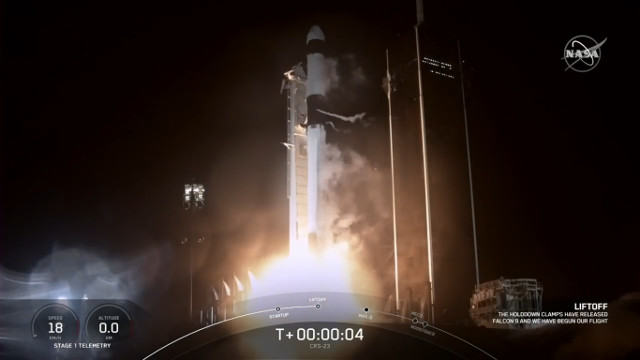
SpaceX's Crew Dragon Endeavour spacecraft blasting off atop a Falcon 9 rocket (Image NASA TV)

A little while ago, SpaceX’s Crew Dragon Endeavour spacecraft blasted off atop a Falcon 9 rocket from Cape Canaveral in its Crew-2 o SpaceX Crew-2 mission. After about eleven minutes, it successfully separated from the rocket’s last stage and went en route to carry out its mission. This is the second crewed mission of the Crew Dragon spacecraft within the normal rotation of the International Space Station crew, the third one overall. This is also the second mission for the Endeavour, used also for the SpX-DM2 mission.