NASA

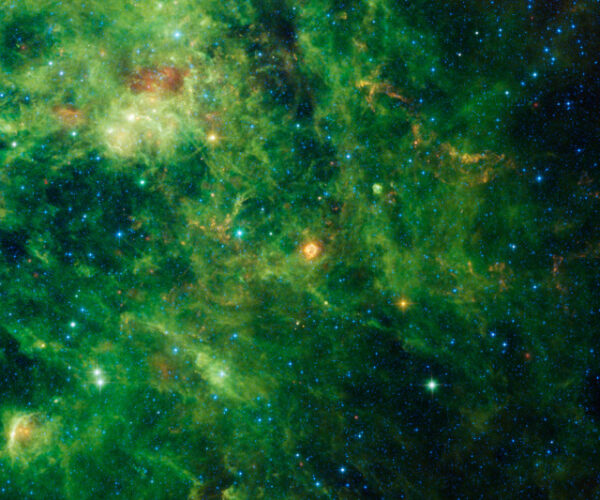
The supernova remnants Cassiopeia A (Image NASA/JPL-Caltech/UCLA)

NASA has released an image of the supernova remnants Cassiopeia A, or simply Cas A, captured by the WISE space telescope at infrareds. There’s no historical record of that supernova even though its light reached Earth around 1667 A.D., probably because a large amount of dust between it and the Earth greatly dimmed its brightness. Its various emissions made it possible to study it with different instruments over the last few decades. WISE detected the echoes of the light burst that are generating ripples outwards from the star that exploded.

The Cygnus Katherine Johnson cargo spacecraft captured by the Canadarm2 robotic arm (Image NASA TV)

Northrop Grumman’s Cygnus spacecraft, launched last Saturday, February 20, has just reached the International Space Station and was captured by the Canadarm2 robotic arm. Astronaut Soichi Noguchi, assisted by his colleague Michael Hopkins, will soon begin the slow maneuver to move the Cygnus until it docks with the Station’s Unity module after about two hours.

The Cygnus Katherine Johnson cargo spacecraft blasting off atop an Antares rocket (Image NASA TV)

A little while ago, Northrop Grumman’s Cygnus spacecraft blasted off atop an Antares rocket from the Mid-Atlantic Regional Spaceport (MARS), part of NASA’s Wallops Flight Facility (WFF) on Wallops Island. After about nine minutes it successfully separated from the rocket’s last stage went en route to its destination. This is its 15th official mission, called NG-15 or CRS NG-15, to transport supplies to the International Space Station for NASA.

The first image of Mars captured by the Mars Rover Perseverance (Photo NASA/JPL-Caltech)

A few hours ago, the Mars Rover Perseverance and the Ingenuity helicopter landed successfully on Mars, in Jezero Crater. Launched on July 30, 2020, these are the two vehicles of NASA’s Mars 2020 mission. With more than 1,000 kg of weight on Earth, Perseverance even surpasses the Mars Rover Curiosity, of which it’s an evolution. For at least a Martian year, it will examine the area of ​​a geologically very interesting crater, collecting samples that mighy be returned to Earth by a future mission.

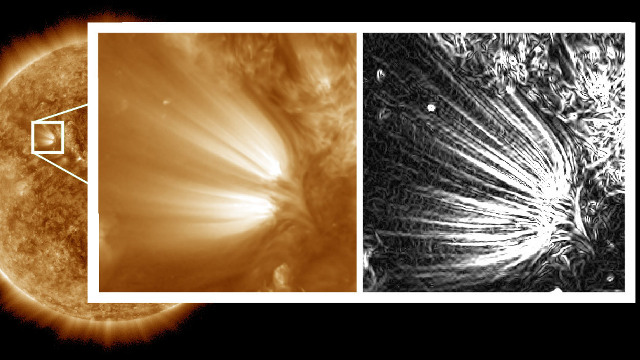
Sun's plumelets (Image NASA/SDO/Uritsky, et al)

An article published in “The Astrophysical Journal” reports a study on some structures that make up the solar plumes which are called plumelets in jargon. A team of researchers led by Vadim Uritsky of the Catholic University of America and NASA’s Goddard Space Flight Center applied cutting-edge image processing algorithms to NASA data to obtain unprecedented resolution images of solar plumelets. These structures are small but this study suggests they may play a crucial role in the solar wind, whose influence extends to the border with interstellar space.