NASA

Gale Crater (Image NASA/JPL-Caltech/ESA/DLR/FU Berlin/MSSS)

NASA’s Mars Rover Curiosity has detected the presence of methane on Mars. The agency hasn’t officially announced the event yet but the New York Times published the information obtained. The detection happened on Wednesday, June 19, and was received by NASA the next day. On Friday, Curiosity mission’s scientists discussed the news reorganizing the weekend activities to carry out a follow-up experiment. There’s no evidence that it was produced by biological processes but methane detections on Mars are always of great interest to scientists.

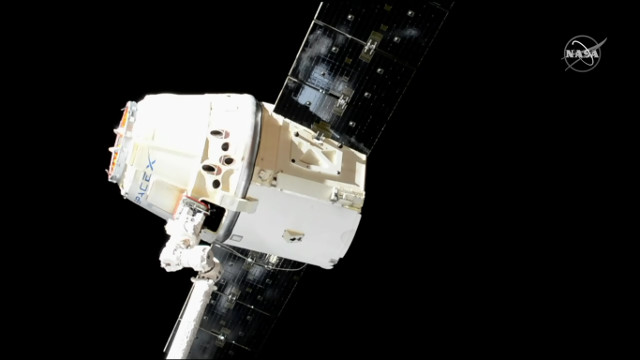
The Dragon cargo spacecraft departing the International Space Station to end its CRS-17 mission (Image NASA TV)

A few hours ago the SpaceX Dragon spacecraft ended its CRS-17 (Cargo Resupply Service 17) mission for NASA splashing down smoothly in the Pacific Ocean a little more than 325 kilometers (about 202 miles) off the coast of California. The Dragon left the International Space Station a few hours earlier.

Shortly after landing, SpaceX boats went to retrieve the Dragon to transport it to the coast. The cargo brought back to Earth will be delivered to NASA soon, probably tomorrow. The Dragon spacecraft reached the International Space Station on May 6, 2019.

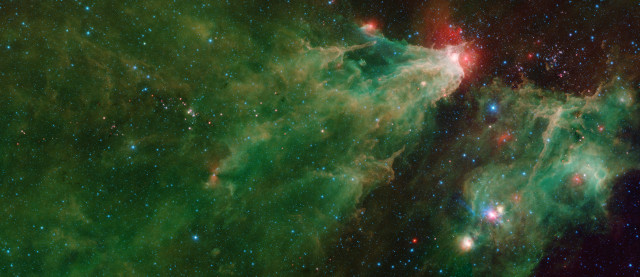
A stellar panorama between the Cepheus C and Cepheus B regions

An article published in “The Astrophysical Journal” reports a study of an area containing a number of star clusters that have a common origin even if their formation had slightly different timescales in the various regions. A team of researchers used NASA’s Spitzer space telescope and Chandra X-ray Observatory to examine the many different objects present between the regions known as Cepheus C and Cepheus B and map the cluster called Cep OB3b.

Ultima Thule image on the cover of Science (Image NASA/Johns Hopkins University Applied Physics Laboratory/Southwest Research Institute/Roman Tkachenko)

An article published in the journal “Science” reports the initial results of the exploration of the Kuiper Belt Object 2014 MU69 nicknamed Ultima Thule by NASA’s New Horizons space probe. There are no particular surprises after the ones arrived thanks to the first images sent to the Earth but the following high-resolution ones along with spectrometric data and other data sent allowed to put together some more details about its characteristics from the mission team.

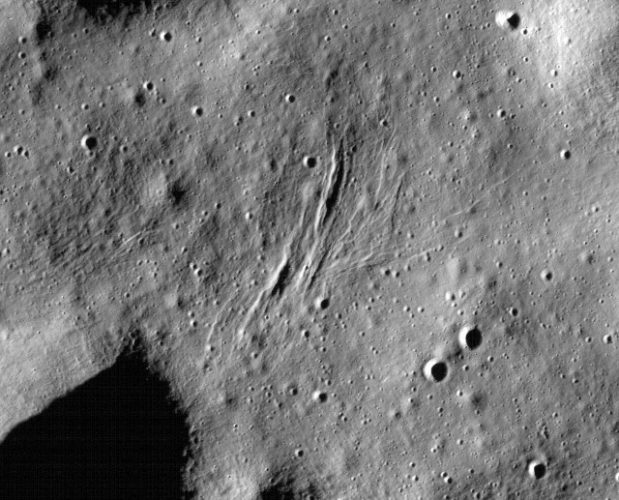
There may still be tectonic activity on the Moon

An article published in the journal “Nature Geoscience” offers clues to the fact that the Moon may still be tectonically active. A team of researchers analyzed images captured by NASA’s Lunar Reconnaissance Orbiter (LRO) space probe in 2010 discovering thousands of tectonic faults generated by the Moon’s progressive shrinking as it cooled down. Some researchers have been working on these geological analyzes since those photos were taken but initially they brought clues about a recent activity while the new clues indicate that an activity still exists.