NASA

Artist's concept of Moon Express lander

At a press conference, NASA administrator Jim Bridenstine announced the new plans for the return to the Moon with the inclusion of a number of private companies that will have the chance to provide their services to send various types of payload. The program called Commercial Lunar Payload Services (CLPS) could start as early as 2019 and represents a first step towards a long-term goal, that is to establish a permanent presence on the Moon with an eye to Mars.

The first image sent by InSight from Mars (Image NASA TV)

NASA has confirmed that its InSight lander has landed on Mars after completing a procedure that’s fully automated as radio signals from Mars take just over eight minutes to reach the Earth in this period. InSight was launched on May 5, 2018. Unlike other landers and rovers, it will study the red planet’s interior to better understand its composition and its geological history.

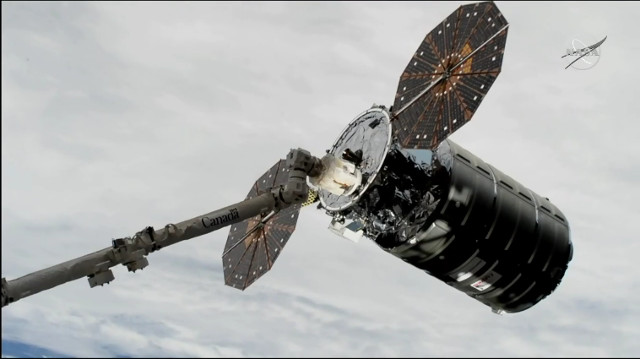
The Cygnus John Young cargo spacecraft captured by Canadarm2 robotic arm (Image NASA TV)

The Northrop Grumman Cygnus spacecraft, launched last Saturday, November 17, has just reached the International Space Station and was captured by Canadarm2 robotic arm. Astronaut Serena Auñón-Chancellor, assisted by her colleague Alexander Gerst, will soon begin the slow maneuver to move the Cygnus until it docks with the Station’s Unity node after about two hours.

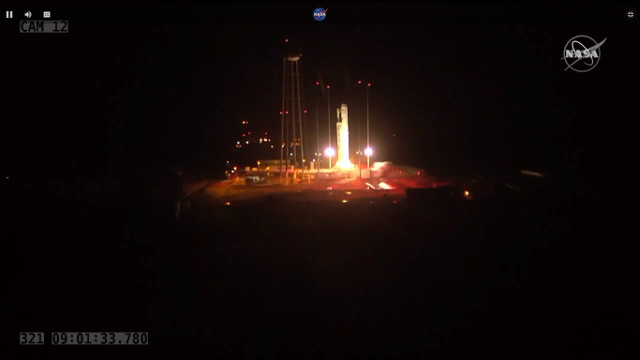
The Cygnus John Young cargo spacecraft blasting off atop an Antares rocket (Image NASA TV)

A little while ago Northrop Grumman’s Cygnus spacecraft blasted off atop an Antares rocket from the Mid-Atlantic Regional Spaceport (MARS), part of NASA’s Wallops Flight Facility (WFF) on Wallops Island. After about nine minutes it successfully separated from the rocket’s last stage went en route to its destination. This is its tenth official mission, called NG-10 but also CRS NG-10, to transport supplies to the International Space Station for NASA.

The Dawn space probe during its preparation (Photo NASA/Amanda Diller)

NASA announced the end of the mission of its Dawn space probe after it ran out of the hydrazine used by its thrusters prevented it from orienting towards Earth to communicate with the mission control through NASA’s Deep Space Network. Dawn is in a stable orbit around the dwarf planet Ceres and will probably remain there for at least 50 years. It’s the only space probe to have orbited two celestial bodies since the first part of its mission was orbiting the giant asteroid Vesta.