NASA

The Lagoon Nebula at visible light (Image NASA, ESA, and STScI)

On April 24, 1990, the Hubble Space Telescope was launched on the Space Shuttle Discovery and put into orbit the next day. To celebrate the 28th anniversary of that event, which represents a milestone in the history of astronomy, new breathtaking photos of the Lagoon Nebula have been published.

About 4,000 light years away from the Earth, the Lagoon Nebula was first cataloged by the astronomer Giovanni Battista Hodierna and later included in other catalogs, so much so that it’s known by various designations including Messier 8 or M8, NGC 6523, Sharpless 25, RCW 146, and Gum 72. In optimal conditions it’s visible even to the naked eye, so it’s the object of observations by amateur astronomers as well.

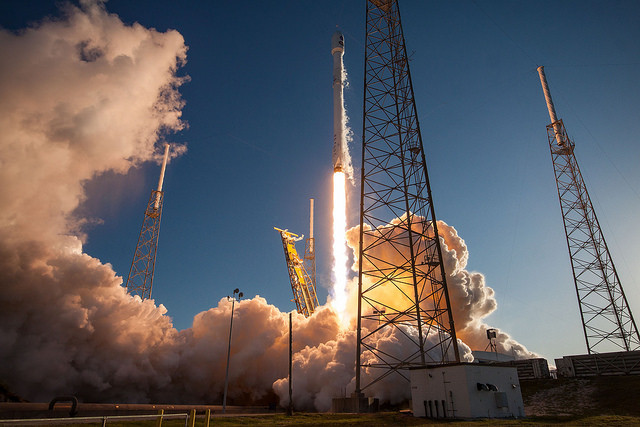
NASA's TESS space telescope blasting off atop a Falcon 9 rocket (Foto SpaceX)

A few hours ago NASA’s TESS space telescope blasted off atop a Falcon 9 rocket from Cape Canaveral. After almost 50 minutes it separated successfully from the rocket’s last stage and reached a transfer orbit where it will start a number of maneuvers that in about two months will take it to the very elliptical final orbit where it will begin its scientific mission.

An infrared 3-D image of Jupiter's North Pole (Image NASA/JPL-Caltech/SwRI/ASI/INAF/JIRAM)

During the general assembly of the European Geosciences Union General Assembly in Vienna, scientists of NASA’s Juno mission showed a 3D map that reproduces cyclones and anticyclones in the planet Jupiter’s polar regions. In particular, they created an animation of a flight over the North Pole. Using data collected by the Juno space probe they were also able to create the first detailed view of the dynamo that powers the planet’s magnetic field.

A Dragon cargo spacecraft starting its CRS-14 mission blasting off atop a Falcon 9 rocket (Photo NASA)

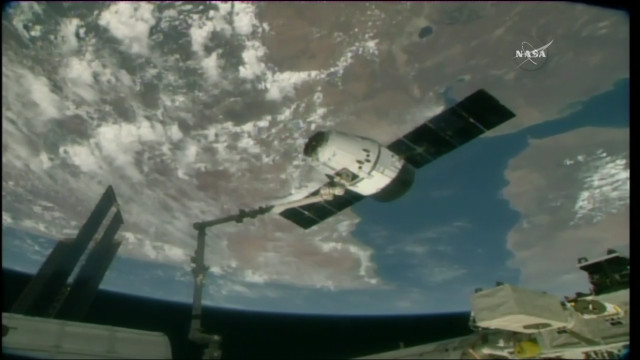
A few hours ago the SpaceX Dragon spacecraft blasted off atop a Falcon 9 rocket from Cape Canaveral in its CRS-14 (Cargo Resupply Service 14) mission, also referred to as SPX-14. After just over ten minutes it separated successfully from the rocket’s last stage and went en route. This is the 14th mission for the Dragon spacecraft to resupply the International Space Station with various cargoes and then return to Earth, again with various cargoes.