NASA

Jupiter's South Pole (Image NASA/JPL-Caltech/SwRI/MSSS/Betsy Asher Hall/Gervasio Robles)

Two articles published in the journal “Science” and a special issue of the journal “Geophysical Research Letters” describe various researches about the planet Jupiter based on data collected by NASA’s Juno space probe. Many scientists participated in one or more of those researches, each focusing on a phenomenon in progress on Jupiter and in the area of ​​influence of its magnetic field, with several news that sometimes are surprising.

A panorama of the area accessing Perseverance Valley (Image NASA/JPL-Caltech)

NASA’s Mars Rover Opportunity has begun its scientific work in yet another Mars area to be explored during a mission that has been going on for over 13 Earth’s years. This mission was extended for the tenth time in 2016 and now its goal is to study “Perseverance Valley”, an ancient valley on the inner slope of the Endeavor crater’s rim to figure out how it formed.

Artist's concept of HAT-P-26b observed by Hubble and Spitzer (Image NASA/GSFC)

An article published in the journal “Science” describes a research on the exoplanet HAT-P-26b, a warm Neptune, meaning a planet of size similar to Neptune that orbits near its star HAT-P-26. A team of researchers from NASA’s Goddard Space Flight Center and the British University of Exeter used the Hubble and Spitzer space telescopes to discover what is called a primitive atmosphere for HAT-P-26b despite its star being old.

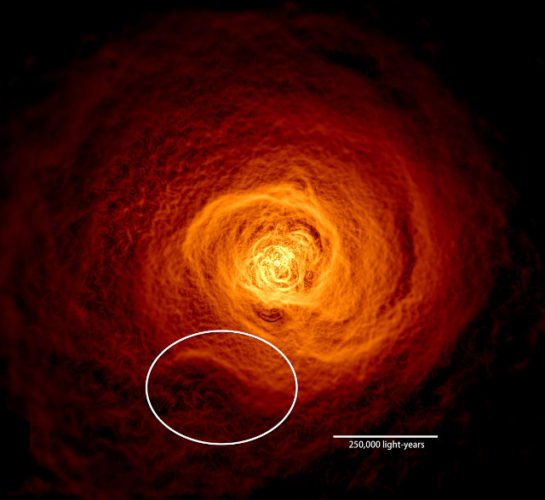
X-ray image of the hot gas in the Perseus galaxy cluster (Image NASA's Goddard Space Flight Center/Stephen Walker et al.)

An article published in the journal “Monthly Notices of the Royal Astronomical Society” describes the discovery of a large wave of hot gas in the Perseus galaxy cluster that extends for about 200,000 light years. A team of astronomers led by Dr. Stephen Walker of NASA’s Goddard Space Flight Center combined observations with NASA’s Chandra X-ray Observatory and others at radio frequencies with computer simulations to study it.