NASA

Artistic concept of the planets in the TRAPPIST-1 system (Image NASA/JPL-Caltech)

NASA held a press conference to communicate new discoveries in the research on the TRAPPIST-1 star system. These results have also been described in an article published in the journal “Nature”. Using data collected by NASA’s Spitzer Telescope, a team of researchers led by MichaĆ«l Gillon of the STAR Institute confirmed the existence of 7 planets in this system, all rocky. Potentially, at least in some region of all those planets there could be liquid water.

SpaceX Dragon cargo spaceship blasting off atop a Falcon 9 rocket to start its CRS-10 mission (Image NASA TV)

A little while ago SpaceX Dragon spacecraft blasted off atop a Falcon 9 rocket from Cape Canaveral in its CRS-10 (Cargo Resupply Service 10) mission, also referred to as SPX-10. After almost ten minutes it separated successfully from the rocket’s last stage and went en route. This is the tenth mission for the Dragon spacecraft to resupply the International Space Station with various cargoes and then return to Earth, again with various cargoes.

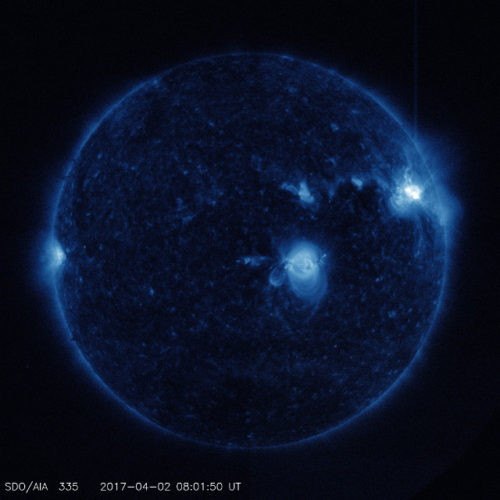
The Sun during a solar flare (Image NASA/NOAA)

NASA released an image of the solar flare occurred on January 21 captured by the GOES-16 satellite that the agency runs with NOAA using the Extreme Ultraviolet and X-Ray Irradiance Sensors (EXIS) instrument. It’s specifically aimed to observe the Sun and monitor phenomena such as solar storms, which can have consequences on the activity of satellites but also of power plants and other human activities.

Global soil moisture map (Image MIT/NASA/JPL-Caltech)

An article published in the journal “Nature Geoscience” describes an analysis of data collected during the first year of NASA’s SMAP satellite’s mission. The results were surprising, especially because the data about the soil’s upper layer has a kind of memory of weather, more than you might think from theoretical models or from incomplete surveys carried out prior to this mission.